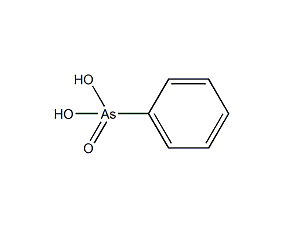
Phenylarsinic acid

Phenylarsinic acid structural formula

Structural formula

Business number 02D6
Molecular formula C6H7AsO3
Molecular weight 202.04
label

Ai3-16050[qr],

Arsonicacid,phenyl-,

Arsonicacid,phenyl-[qr],

Kyselinabenzenarsonova,

Monophenylarsonic acid,

Phenylarsenic acid,

Phenyl-arsonicaci,

Phenylarsonic acid[qr]

Numbering system

CAS number:98-05-5

MDL number:MFCD00002097

EINECS number:202-631-9

RTECS number:CY3150000

BRN number:None

PubChem ID:None

Physical property data

1. Characteristics: White crystalline powder.


2. Density (g/mL,25?): 1.76


3. Relative vapor density (g/mL,air =1): Undetermined


4. Melting point (ºC): 160


5. Boiling point (ºC,normal pressure): Undetermined


6. Boiling point (ºC, kPa): Not determined


7. Refractive index: Undetermined


8. Flashpoint (ºC): Undetermined


9. Specific optical rotation (º): Undetermined


10. Autoignition point or ignition temperature (ºC?: Undetermined


11. Vapor pressure (mmHg, 55ºC): Undetermined


12. Saturated vapor pressure (kPa, 25 ºC): Not determined


13. Heat of combustion (KJ/mol): Undetermined


14. Critical temperature (ºC): Undetermined


15. Critical pressure (KPa): Undetermined


16. Oil and water (octanol/Log value of the partition coefficient (water): undetermined


17. Explosion limit (%,V/V): Undetermined


18. Lower explosion limit (%,V/V): Undetermined


19. Solubility: Undetermined

Toxicological data

Acute toxicity: Rat oral LD50: 50mg/kg;
 MouseOral LD50?270?g/kg;
-US; mso-fareast-language: ZH-CN; mso-bidi-language: AR-SA”>Rabbit intravenous injectionLD50:16mg/kg;

Ecological data

It is extremely harmful to water and toxic to fish. Do not let the product enter the water body.

Molecular structure data

None

Compute chemical data

1. Reference value for hydrophobic parameter calculation (XlogP):


2. Number of hydrogen bond donors: 2


3. Number of hydrogen bond acceptors: 3


4. Number of rotatable chemical bonds: 1


5. Number of tautomers:


6. Topological molecular polar surface area (TPSA): 57.5


7. Number of heavy atoms: 10


8. Surface charge: 0


9. Complexity: 145


10. Number of isotope atoms: 0


11. Determine the number of atomic stereocenters: 0


12. The number of uncertain atomic stereocenters: 0


13. Determine the number of stereocenters of chemical bonds: 0


14. Uncertain number of chemical bond stereocenters: 0


15. Number of covalent bond units: 1

Properties and stability

Does not decompose under normal temperature and pressure. Avoid contact with oxidants.

Storage method

Stored in a cool, ventilated warehouse. Keep away from fire and heat sources. should be kept away from oxidizer, do not store together. Use explosion-proof lighting and ventilation facilities. It is prohibited to use mechanical equipment and equipment that are prone to sparks
Tools. The storage area should be equipped with emergency release equipment and suitable containment materials.

Synthesis method

After diazotization of aniline and Arsenous acid reaction is obtained.

Purpose

is used as an analytical reagent.

extended-reading:https://www.bdmaee.net/wp-content/uploads/2022/08/88-1.jpg
extended-reading:https://www.newtopchem.com/archives/39941
extended-reading:https://www.newtopchem.com/archives/44279
extended-reading:https://www.bdmaee.net/bismuth-octoate/
extended-reading:https://www.cyclohexylamine.net/catalyst-a400-polyurethane-catalyst-a400/
extended-reading:https://www.newtopchem.com/archives/44374
extended-reading:https://www.bdmaee.net/dabco-ne600-catalyst-cas10861-07-1-evonik-germany/
extended-reading:https://www.bdmaee.net/wp-content/uploads/2016/05/Lupragen-N205-MSDS.pdf
extended-reading:https://www.bdmaee.net/drier-butyl-tin-oxide-fascat-4101/
extended-reading:https://www.morpholine.org/dabco-dc2-delayed-catalyst-dabco-dc2/
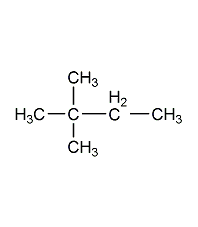
neopentyl alcohol

Neopentyl alcohol structural formula

Structural formula

Business number 01K8
Molecular formula C5H12O
Molecular weight 88.15
label

2,2-Methyl-1-propanol,

tert-butylmethanol,

tert-Butyl carbinol,

2,2-Dimethylpropanol,

Neopentanol,

Neopentyl alcohol,

alcohol solvents,

aliphatic compounds

Numbering system

CAS number:75-84-3

MDL number:MFCD00004682

EINECS number:200-907-3

RTECS number:None

BRN number:1730984

PubChem number:24865983

Physical property data

1. Properties: colorless crystals with mint smell.

2. Density (g/mL, 20?): 0.811

3. Solubility parameter (J·cm-3)0.5 : 19.265

4. Melting point (ºC): 52.5

5. Boiling point (ºC, normal pressure): 113~114

6. van der Waals area (cm2·mol-1): 9.170×10⁹

7. Refractive index ( 50ºC): 1.3915

8. Flash point (ºC, closed): 36

9. van der Waals volume (cm3·mol -1): 62.610

10. Gas phase standard entropy (J·mol-1·K-1): 366.85 p>

11. Liquid phase standard combustion heat (enthalpy) (kJ·mol-1): -3283.2

12. Liquid phase standard claimed heat (enthalpy) ( kJ·mol-1): -399.4

13. Liquid phase standard entropy (J·mol-1·K-1): 229.3

14. Liquid phase standard free energy of formation (kJ·mol-1): -175.23

15. Critical pressure ( KPa): Undetermined

16. Log value of oil-water (octanol/water) partition coefficient: Undetermined

17. Explosion upper limit (%, V/V): Undetermined

18. Lower explosion limit (%, V/V): Undetermined

19. Solubility (%, water, 20ºC): 0.039

20. Dissolution Properties: Slightly soluble in water, miscible with many organic solvents such as alcohols, ethers, ketones, esters and aromatic hydrocarbons, and also miscible with mineral oil and vegetable oil.

Toxicological data

None

Ecological data

None

Molecular structure data

1. Molar refractive index: 26.71

2. Molar volume (cm3/mol): 108.6

3. Isotonic specific volume (90.2K ):242.9

4. Surface tension (dyne/cm): 25.0

5. Polarizability (10-24cm3) :10.59

Compute chemical data

1. Reference value for hydrophobic parameter calculation (XlogP): None

2. Number of hydrogen bond donors: 1

3. Number of hydrogen bond acceptors: 1

4. Number of rotatable chemical bonds: 1

5. Number of tautomers: none

6. Topological molecule polar surface area 20.2

7. Number of heavy atoms: 6

8. Surface charge: 0

9. Complexity: 33.7

10. Number of isotope atoms: 0

11. Determine the number of atomic stereocenters: 0

12. Uncertain number of atomic stereocenters: 0

13. Determine the number of chemical bond stereocenters: 0

14. Number of uncertain chemical bond stereocenters: 0

15. Number of covalent bond units: 1

Properties and stability

1. It has the chemical reactivity of primary alcohols. Highly flammable. When using, avoid inhaling the dust of this product and avoid contact with eyes and skin.

2. Exist in smoke.

Storage method

This product should be sealed and stored in a cool place.

Synthesis method

1. Preparation method:

In a reaction bottle equipped with a stirrer, thermometer, and dropping funnel, add 800g of 30% hydrogen peroxide, cool it in an ice bath, and add dropwise a dilute solution composed of 800g of concentrated sulfuric acid and 310g of crushed ice while stirring and cool it to below 10°C. For sulfuric acid, control it at 5-10°C and finish adding it in about 20 minutes. Then, 224.4g (2.0mol) of 2,4,4-trimethyl-1-pentene (2) was added dropwise, and the addition was completed in 5 to 10 seconds. Remove the ice bath and stir the reaction at 25°C for 24 hours. Separate the organic layer and cool it in an ice bath, add 500g of 70% sulfuric acid dropwise with vigorous stirring, and keep the internal temperature at 15 to 25°C, which will take about 67 to 75 minutes. After the addition is completed, stir at 5 to 10°C for 30 minutes. Leave to stand for 1 to 3 hours, separate the organic layer, pour into 1000 mL of water, and distill under normal pressure (foam may appear, and distillation can be stopped at this time). After cooling the distilled liquid, separate the organic layer, dry it over anhydrous sodium sulfate?, fractionate, collect the fractions between 111 and 113°C to obtain 2,2-dimethyl-1-propanol ?(1) 60?70, yield 34%?40%. Note: ? Dry thoroughly before distillation, otherwise the product will form an azeotrope (80~85?) with water, which will affect the yield. ? This reaction is similar to the hydrogen peroxide oxidation of ethyl-propyl benzene to produce phenol and acetone. Under acidic conditions, the peroxide is rearranged to produce alcohol and acetone. [1]

Purpose

Solvent, raw material for organic synthesis. ?

extended-reading:https://www.bdmaee.net/dimethylethanolamine/
extended-reading:https://www.newtopchem.com/archives/1885
extended-reading:https://www.bdmaee.net/nt-cat-pc17-catalyst-cas110-18-9-newtopchem/
extended-reading:https://www.bdmaee.net/wp-content/uploads/2022/08/TIB-KAT-129.pdf
extended-reading:https://www.bdmaee.net/cas-1067-33-0-3/
extended-reading:https://www.bdmaee.net/niax-dmee-low-odor-reactive-catalysts-momentive/
extended-reading:https://www.cyclohexylamine.net/dabco-8154-2-ethylhexanoic-acid-solution-of-triethylenediamine/
extended-reading:https://www.newtopchem.com/archives/40238
extended-reading:https://www.bdmaee.net/dabco-r-8020-jeffcat-td-20-teda-a20/
extended-reading:https://www.newtopchem.com/archives/690

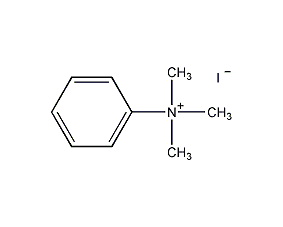
Phenyltrimethylammonium iodide

Phenyltrimethylammonium iodide structural formula

Structural formula

Business number 02D5
Molecular formula C9H14IN
Molecular weight 263.12
label

Trimethylphenylammonium iodide,

Phenyltrimethylamine iodide,

(CH3)3N(I)C6H5,

N,n,n-trimethylaniliniumiodide,

N,n,n-trimethyl-benzenaminiuiodide,

N,n,n-trimethylbenzenaminiiumiodide,

N,n-dimethylanilinemethiodide,

Phenyltrimethyl-ammoniodide,

Trimethylanilliniumiodide,

Trimethylphenyl-ammoniuiodide,

Phenyltrimethylammonium iodide

Numbering system

CAS number:98-04-4

MDL number:MFCD00011791

EINECS number:202-630-3

RTECS number:BT2450000

BRN number:3916752

PubChem number:24849650

Physical property data

1. Appearance: white powder.


2. Density (g/mL,25?): Undetermined


3. Relative vapor density ( g/mL,Air =1): Undetermined


4. Melting point (ºC): 227


5. Boiling point (ºC,normal pressure): Undetermined


6. Boiling point (ºC, kPa): Not determined


7. Refractive index: Undetermined


8. Flashpoint (ºC): Undetermined


9. Specific optical rotation (º): Undetermined


10. Autoignition point or ignition temperature (ºC?: Undetermined


11. Vapor pressure (mmHg, 55ºC): Undetermined


12. Saturated vapor pressure (kPa, 25 ºC): Not determined


13. Heat of combustion (KJ/mol): Undetermined


14. Critical temperature (ºC): Undetermined


15. Critical pressure (KPa): Undetermined


16. Oil and water (octanol/Log value of the partition coefficient (water): undetermined


17. Explosion upper limit (%,V/V): Undetermined


18. Lower explosion limit (%,V/V): Undetermined


19. Solubility: Undetermined

Toxicological data

Acute toxicity: Mouse peritoneal cavity LD50: 55mg/kg;
-US; mso-fareast-language: ZH-CN; mso-bidi-language: AR-SA”>Mouse subcutaneous LD50: 85mg /kg;
??MouseIntravenous injectionLD50?5620?g/kg;

Ecological data

This substance is slightly harmful to water.

Molecular structure data

None

Compute chemical data

1. Reference value for hydrophobic parameter calculation (XlogP):


2. Number of hydrogen bond donors: 0


3. Number of hydrogen bond acceptors: 1


4. Number of rotatable chemical bonds: 1


5. Number of tautomers:


6. Topological molecular polar surface area (TPSA):0


7. Number of heavy atoms: 11


8. Surface charge: 0


9. Complexity: 95.8


10. Number of isotope atoms: 0


11. Determine the number of atomic stereocenters: 0


12. The number of uncertain atomic stereocenters: 0


13. Determine the number of stereocenters of chemical bonds: 0


14. Uncertain number of chemical bond stereocenters: 0


15. Covalent bond unit?Quantity: 2

Properties and stability

Avoid contact with oxidants and light.

Storage method

Stored in a cool, ventilated warehouse. Keep away from fire and heat sources. should be kept away from oxidizer, do not store together. Store in dark place. Use explosion-proof lighting and ventilation facilities. Do not use sparks easily
machinery, equipment and tools. The storage area should be equipped with emergency release equipment and suitable containment materials.

Synthesis method

None

Purpose

None

extended-reading:https://www.newtopchem.com/archives/830
extended-reading:https://www.newtopchem.com/archives/933
extended-reading:https://www.bdmaee.net/polyurethane-rigid-foam-catalyst-cas15875-13-5-jeffcat-tr-90/
extended-reading:https://www.newtopchem.com/archives/40263
extended-reading:https://www.newtopchem.com/archives/683
extended-reading:https://www.bdmaee.net/dioctyltin-dilaurate-dotdl/
extended-reading:https://www.newtopchem.com/archives/44045
extended-reading:https://www.bdmaee.net/n-formylmorpholine-cas4394-85-8-4-formylmorpholine/
extended-reading:https://www.bdmaee.net/low-odor-catalyst-9727/
extended-reading:https://www.bdmaee.net/2-4-6-trisdimethylaminomethylphenol/