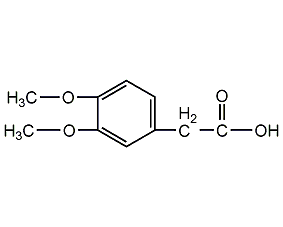
Hoverteric acid

Homovertebrate acid structure

Structural formula

Business number 0267
Molecular formula C10H12O4
Molecular weight 196.2
label

3,4-Dimethoxyphenylacetic acid,

(3,4-Dimethoxyphenyl)acetic acid,

3,4-Dimethoxyphenylacetic acid,

(3,4-dimethoxy)acetic acid,

(3,4-Dimethoxyphenyl)acetic acid

Numbering system

CAS number:93-40-3

MDL number:MFCD00004335

EINECS number:202-244-5

RTECS number:AH0675000

BRN number:1110282

PubChem number:24893270

Physical property data

1. Properties: Products containing one molecule of crystal water are needle-shaped crystals. The product that precipitates from benzene or petroleum ether is anhydrous.

2. Density (g/mL, 25/4?): Undetermined

3. Relative vapor density (g/mL, air=1): Undetermined

4. Melting point (ºC): 80?82? (98?99?, anhydrous).

5. Boiling point (ºC, normal pressure): Not determined

6. Boiling point (ºC, 5.2kPa): Undetermined

7. Refractive index: Undetermined

8. Flash point (ºC): Undetermined

9. Specific rotation (º): Undetermined

10. Autoignition point or ignition Combustion temperature (ºC): Undetermined

11. Vapor pressure (kPa, 25ºC): Undetermined

12. Saturated vapor pressure (kPa, 60ºC): Undetermined

13. Heat of combustion (KJ/mol): Undetermined

14. Critical temperature (ºC): Undetermined

15. Critical pressure (KPa): Undetermined

16. Logarithmic value of oil-water (octanol/water) partition coefficient: Undetermined

17. Explosion upper limit (%, V/V): Undetermined

18. Lower explosion limit (%, V/V): Undetermined

19. Solubility: Soluble in water, ethanol and ether.

Toxicological data

None

Ecological data

None

Molecular structure data

1. Molar refractive index: 50.72

2. Molar volume (cm3/mol): 164.8

3. Isotonic specific volume (90.2K ): 419.0

4. Surface tension (dyne/cm): 41.7

5. Polarizability (10-24cm3): 20.10

Compute chemical data

1. Reference value for hydrophobic parameter calculation (XlogP): None

2. Number of hydrogen bond donors: 1

3. Number of hydrogen bond acceptors: 4

4. Number of rotatable chemical bonds: 4

5. Number of tautomers: none

6. Topological molecule polar surface area 55.8

7. Number of heavy atoms: 14

8. Surface charge: 0

9. Complexity: 193

10. Number of isotope atoms: 0

11. Determine the number of atomic stereocenters: 0

12. Uncertain number of atomic stereocenters: 0

13. Determine the number of chemical bond stereocenters: 0

14. Number of uncertain chemical bond stereocenters: 0

15. Number of covalent bond units: 1

Properties and stability

None

Storage method

This product should be kept sealed.

Synthesis method

None

Purpose

Used in organic synthesis. ?

extended-reading:https://www.bdmaee.net/wp-content/uploads/2022/08/31.jpg
extended-reading:https://www.cyclohexylamine.net/di-n-octyl-tin-dilaurate-dioctyltin-dilaurate-dotdl/
extended-reading:https://www.newtopchem.com/archives/40287
extended-reading:https://www.bdmaee.net/wp-content/uploads/2022/08/FASCAT4224-catalyst-CAS-68298-38-4-dibutyl-tin-bis-1-thioglycerol.pdf
extended-reading:https://www.bdmaee.net/wp-content/uploads/2022/08/Toluene-diisocyanate-TDI-TDI-trimer.pdf
extended-reading:https://www.bdmaee.net/anhydrous-tin-tetrachloride-cas-7646-78-8-tin-tetrachloride/
extended-reading:https://www.bdmaee.net/kosmos-29-catalyst-cas301-10-0-degussa-ag/
extended-reading:https://www.cyclohexylamine.net/category/product/page/24/
extended-reading:https://www.cyclohexylamine.net/2-2-aminoethylaminoethanol/
extended-reading:https://www.cyclohexylamine.net/dabco-bx405-low-odor-strong-gel-amine-catalyst-bx405/
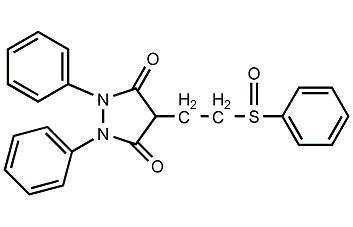
Sulfinpyrazone

Sulfinpyrazone Structural Formula

Structural formula

Business number 0194
Molecular formula C23H20N2O3S
Molecular weight 404.48
label

1,2-diphenyl-4-(2-(phenylsulfinyl)ethyl)-3,5-pyrazolidinedione,

1,2-Diphenyl-4-(phenylsulfinylethyl)-3,5-pyrazolidinedione

Numbering system

CAS number:57-96-5

MDL number:MFCD00057279

EINECS number:200-357-4

RTECS number:UQ8575000

BRN number:None

PubChem number:24899841

Physical property data

None

Toxicological data

1, acute toxicity: human oral TDLo: 29mg/kg; rat oral LD50: 358mg/kg; rat intravenous LDLo: 154mg/kg; mouse oral LD50: .298mg/kg;
Mouse abdominal cavity LD50: 100mg/kg; Mouse vein LD50: 240mg/kg; Rabbit intravenous LD50: 195mg/ kg
2, mutagenicity: sex chromosomes Loss and nondisjunctionTEST system: mold Aspergillus nidulans: 1mg/L

Ecological data

None

Molecular structure data

5. Molecular property data:


1. Molar refractive index: 114.13


2. Molar volume (m3/mol??290.0


3. isotonic specific volume (90.2K):856.1


4. Surface Tension (dyne/cm):75.9


5. Polarizability?10-24cm3): 45.24

Compute chemical data

1. Reference value for hydrophobic parameter calculation (XlogP): None

2. Number of hydrogen bond donors: 0

3. Number of hydrogen bond acceptors: 4

4. Number of rotatable chemical bonds: 6

5. Number of tautomers: 2

6. Topological molecule polar surface area 76.9

7. Number of heavy atoms: 29

8. Surface charge: 0

9. Complexity: 571

10. Number of isotope atomsAmount: 0

11. Determine the number of atomic stereocenters: 0

12. Uncertain number of atomic stereocenters: 1

13. Determine the chemical bond position Number of stereocenters: 0

14. Number of uncertain chemical bond stereocenters: 0

15. Number of covalent bond units: 1

Properties and stability

None

Storage method

None

Synthesis method

None

Purpose

None

extended-reading:https://www.bdmaee.net/sponge-foaming-catalyst-smp/
extended-reading:https://www.bdmaee.net/wp-content/uploads/2022/08/81.jpg
extended-reading:https://www.bdmaee.net/delayed-amine-a-400/
extended-reading:https://www.bdmaee.net/wp-content/uploads/2022/08/33-9.jpg
extended-reading:https://www.newtopchem.com/archives/776
extended-reading:https://www.bdmaee.net/jeffcat-dpa-catalyst-cas63469-23-8-huntsman/
extended-reading:https://www.bdmaee.net/kosmos-29-catalyst-cas301-10-0-degussa-ag/
extended-reading:https://www.bdmaee.net/fentacat-10-catalyst-cas100-42-5-solvay/
extended-reading:https://www.bdmaee.net/cas-818-08-6-2/
extended-reading:https://www.newtopchem.com/archives/44682

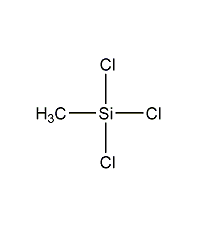
Methyltrichlorosilane

Methyltrichlorosilane structural formula

Structural formula

Business number 01K4
Molecular formula CH3Cl3Si
Molecular weight 149.48
label

Methylsilane,

Trichloromethylsilane,

Monomethyltrichlorosilane,

Methyl silicon trichloride,

Methyltrichlorosilane,

Methyltrichlorosilane,

Methyltriehlorosilane,

Methyl silicochloroform,

Methylsilicon trichloride,

Elemental organic compounds

Numbering system

CAS number:75-79-6

MDL number:MFCD00000481

EINECS number:200-902-6

RTECS number:VV4550000

BRN number:1361381

PubChem number:24897271

Physical property data

1. Properties: colorless liquid with pungent odor and easy to deliquesce. [1]

2. Melting point (?): -90[2]

3. Boiling point (?): 66.4[3]

4. Relative density (water = 1): 1.28[4]

5. Relative vapor Density (air=1): 5.2[5]

6. Saturated vapor pressure (kPa): 17.9 (20?)[6]

7. Critical pressure (MPa): 3.53[7]

8. Octanol/water partition coefficient: 2.01[8]

9. Flash point (?): -9 (CC); 7.2 (OC) [9]

10. Ignition temperature ( ?): 490[10]

11. Explosion upper limit (%): 11.9[11]

12. Explosion Lower limit (%): 7.2[12]

13. Solubility: soluble in benzene and ether. [13]

Toxicological data

1. Skin/eye irritation

Standard Draize test: rabbit, skin contact: 500?L; severity of reaction: severe.

Standard Draize test: Rabbit, eye contact: 5mg/24H; Severity of reaction: Severe.

2. Acute toxicity: Rat oral LD50: 1620?L/kg; rat inhalation LC50: 450ppm/4H; rat intraperitoneal LDLo: 30mg/kg; mouse inhalation LC50: 180mg/ m3/2H; Rabbit skin contact LD50: 840?L/kg;

3. Acute toxicity[14]

LD50: 1620?l (2173.6mg)/kg (rat oral); 840?l (1075.2mg)/kg (rabbit transdermal)

LC50 : 450ppm (rat inhalation, 4h)

4. Irritation[15]

Rabbit transdermal: 500?l, severe stimulation.

Rabbit eye: 5mg (24h), severe irritation.

Ecological data

1. Slightly harmful to water, avoid undiluted or large amounts of product coming into contact with groundwater, waterways or sewage systems.

2. Ecotoxicity No data available

3. Biodegradability No data

4. Non-biodegradabilityNo information yet

Molecular structure data

1. Molar refractive index: 29.94

2. Molar volume (cm3/mol): 114.9

3. Isotonic specific volume (90.2K ): 246.4

4. Surface tension (dyne/cm): 21.1

5. Polarizability (10-24cm3): 11.87 p>

Compute chemical data

1. Reference value for hydrophobic parameter calculation (XlogP): None

2. Number of hydrogen bond donors: 0

3. Number of hydrogen bond acceptors: 0

4. Number of rotatable chemical bonds: 0

5. Number of tautomers: none

6. Topological molecule polar surface area 0

7. Number of heavy atoms: 5

8. Surface charge: 0

9. Complexity: 28.4

10. Number of isotope atoms: 0

11. Determine the number of atomic stereocenters: 0

12. Uncertain number of atomic stereocenters: 0

13. Determine the number of chemical bond stereocenters: 0

14. Number of uncertain chemical bond stereocenters: 0

15. Number of covalent bond units: 1

Properties and stability

1. Stability[16] Stable

2. Incompatible substances[17] Strong acid, strong alkali, strong oxidant, water

3. Conditions to avoid contact[18] Humid air, heat

4. Polymerization hazard[19] Polymerization

5. Decomposition products[20] Hydrogen chloride

Storage method

Storage Precautions[21] Store in a cool, ventilated warehouse. Keep away from fire and heat sources. The storage temperature should not exceed 37?. The packaging must be sealed and must not come into contact with air. They should be stored separately from oxidants, acids, alkalis, etc. and avoid mixed storage. Use explosion-proof lighting and ventilation facilities. It is prohibited to use mechanical equipment and tools that are prone to sparks. The storage area should be equipped with emergency release equipment and suitable containment materials.

Synthesis method

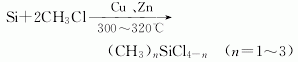
Methyl chloride and silicon powder are directly synthesized in the presence of cuprous chloride catalyst in the next step to generate a methylchlorosilane mixture, which is purified by distillation to obtain the product dimethyldichlorosilane. Then use vacuum distillation to separate and purify. ???

Purpose

Used in the manufacture of silicone compounds. [22]

extended-reading:https://www.newtopchem.com/archives/category/products/page/161
extended-reading:https://www.bdmaee.net/cas814-94-8/
extended-reading:https://www.newtopchem.com/archives/76
extended-reading:https://www.bdmaee.net/wp-content/uploads/2022/08/Polyurethane-thermal-delay-catalyst-NT-CATE-129-heat-sensitive-metal-catalyst.pdf
extended-reading:https://www.bdmaee.net/toyocat-et/
extended-reading:https://www.newtopchem.com/archives/category/products/page/71
extended-reading:https://www.cyclohexylamine.net/foaming-retarder-high-rebound-retardation-catalyst-high-rebound-delayed-catalyst-c-225/
extended-reading:https://www.newtopchem.com/archives/40526
extended-reading:https://www.bdmaee.net/pc-cat-td33eg-catalyst/
extended-reading:https://www.newtopchem.com/archives/44024