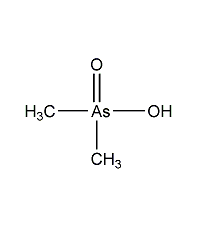
cacodylic acid

Dimethylarsinic acid structural formula

Structural formula

Business number 01JV
Molecular formula C2H7AsO2
Molecular weight 138.00
label

Dimethylarsinic acid,

herbicide

Numbering system

CAS number:75-60-5

MDL number:MFCD00002095

EINECS number:200-883-4

RTECS number:CH7525000

BRN number:1736965

PubChem number:24892235

Physical property data


1. Characteristics: colorless crystals.


2. Density (g/mL,25/4?): Unsure


3. Relative vapor density (g/mL,AIR=1): Unsure


4. Melting point (ºC):192 -198?


5. Boiling point (ºC,Normal pressure): Uncertain


6. Boiling point (ºC,5.2kPa): Unsure


7. Refractive index: Uncertain


8. Flash Point (ºC): Unsure


9. Specific optical rotation (º): Unsure


10. Autoignition point or ignition temperature (ºC): Unsure


11. Vapor pressure (kPa,25ºC): Unsure


12. Saturated vapor pressure (kPa,60ºC): Unsure


13. Heat of combustion (KJ/mol): Unsure


14. Critical temperature (ºC): Unsure


15. Critical pressure (KPa): Unsure


16. Oil and water (octanol/Logarial value of partition coefficient for water: Uncertain


17. Explosion limit (%,V/V): Unsure


18. Lower explosion limit (%,V/V): Unsure


19. Solubility:25Solubility in water at ? is200g/100g,Soluble in lower alcohols.


Toxicological data

1, acute toxicity: rat oral administrationLD50?644mg/kg; rat by inhalationLCLo?2600mg/m3/2H .

Ecological data

It is extremely harmful to water, even in small amounts, to fish and floating fish in water bodies Creatures are poisonous


It is highly toxic to organic matter in the water and fish.

Molecular structure data

None

Compute chemical data

1. Reference value for hydrophobic parameter calculation (XlogP):


2. Number of hydrogen bond donors: 1


3. Number of hydrogen bond acceptors: 2


4. Number of rotatable chemical bonds: 0


5. Number of tautomers:


6. Topological molecular polar surface area (TPSA):37.3


7. Number of heavy atoms: 5


8. Surface charge: 0


9. Complexity: 62


10. Number of isotope atoms: 0


11. Determine the number of atomic stereocenters: 0


12. The number of uncertain atomic stereocenters: 0


13. Determine the number of stereocenters of chemical bonds: 0


14. Uncertain number of chemical bond stereocenters: 0


15. Covalent Number of key units: 1

Properties and stability

Reacts with moisture, air, and oxides.


Storage method

Store airtightly,Store in a cool, dark place Dry warehouse. Avoid contact with moisture, water, and air.

Synthesis method

Reduced by disodium methylarsinate with sulfur dioxide, and then under alkaline conditions It reacts with methyl chloride to form sodium dimethylarsinate, and then it is treated with hydrochloric acid.

Purpose

Used to control weeds in non-crop fields,Dosage10?15kg/ha

extended-reading:https://www.newtopchem.com/archives/45041
extended-reading:https://www.newtopchem.com/archives/44233
extended-reading:https://www.bdmaee.net/cas-1704-62-7/
extended-reading:https://www.bdmaee.net/dioctyl-dimaleate-di-n-octyl-tin/
extended-reading:https://www.newtopchem.com/archives/40372
extended-reading:https://www.cyclohexylamine.net/catalyst-1028-polyurethane-catalyst-1028/
extended-reading:https://www.bdmaee.net/toyocat-np-catalyst-tosoh/
extended-reading:https://www.bdmaee.net/niax-k-zero-3000-trimer-catalyst-momentive/
extended-reading:https://www.bdmaee.net/polyurethane-reaction-inhibitor/
extended-reading:https://www.bdmaee.net/pc-cat-np30-catalyst-trisdimethylaminomethylphenol/
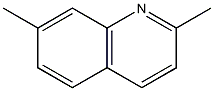
2,7-dimethylquinoline

2,7-dimethylquinoline structural formula

Structural formula

Business number 0266
Molecular formula C11H11N
Molecular weight 157.21
label

2,7-Methylquinaldine,

m-Toluquinaldine

Numbering system

CAS number:93-37-8

MDL number:MFCD00006763

EINECS number:202-242-4

RTECS number:None

BRN number:None

PubChem number:24848739

Physical property data

1. Properties: needle-like crystals.

2. Density (g/mL, 25/4?): 1.0611.

3. Relative vapor density (g/mL, air=1): Undetermined

4. Melting point (ºC): 61

5. Boiling point ( ºC, normal pressure): 264?265

6. Boiling point (ºC, 5.2kPa): Undetermined

7. Refractive index: 1.6075.

8. Flash point (ºC): Not determined

9. Specific rotation (º): Undetermined

10. Autoignition point or ignition temperature (ºC): Undetermined

11. Vapor pressure (kPa, 25ºC): Undetermined

12. Saturated vapor pressure (kPa, 60ºC): Undetermined

13. Heat of combustion (KJ/mol): Undetermined

14. Critical temperature (ºC): Undetermined

15. Critical pressure (KPa): Undetermined

p>

16. The logarithmic value of the oil-water (octanol/water) partition coefficient: Undetermined

17. The upper limit of explosion (%, V/V): Undetermined

18. Lower explosion limit (%, V/V): Undetermined

19. Solubility: Soluble in ethanol, ether and benzene.

Toxicological data

None

Ecological data

None

Molecular structure data

1. Molar refractive index: 51.83

2. Molar volume (cm3/mol): 149.3

3. Isotonic specific volume (90.2K ): 380.5

4. Surface tension (dyne/cm): 42.1

5. Polarizability (10-24cm3): 20.54

Compute chemical data

1. Reference value for hydrophobic parameter calculation (XlogP): 3

2. Number of hydrogen bond donors: 0

3. Number of hydrogen bond acceptors: 1

4. Number of rotatable chemical bonds: 0

5. Number of tautomers: none

6. Topological molecule polar surface area 12.9

7. Number of heavy atoms: 12

8. Surface charge: 0

9. Complexity: 155

10. Number of isotope atoms: 0

11. Determine the number of atomic stereocenters: 0

12. Uncertain number of atomic stereocenters: 0

13. Determine the number of chemical bond stereocenters: 0

14. Number of uncertain chemical bond stereocenters: 0

15. Number of covalent bond units: 1

Properties and Stability

None

Storage method

This product should be sealed and stored away from light.

Synthesis method

Heat the aniline with iodine to 170-175°C, add acetone dropwise, and stir vigorously while collecting the distillate. Aniline and the middle fraction 2,2,4 trimethyl-1,2-dihydroquinoline are separated from the reaction mixture and distillate by distillation under reduced pressure. The latter is heated and reacted with anhydrous aniline, metallic sodium and copper powder, and fractionated under reduced pressure from the reactants to obtain 2,4-dimethylquinoline with a yield of 80-90%.

Purpose

Used in organic synthesis. Dye intermediates. ??

extended-reading:https://www.bdmaee.net/niax-ef-712-low-emission-tertiary-amine-catalyst-momentive/
extended-reading:https://www.newtopchem.com/archives/44310
extended-reading:https://www.newtopchem.com/archives/1769
extended-reading:https://www.bdmaee.net/teda-catalyst-triethylene-diamine-tosoh/
extended-reading:https://www.cyclohexylamine.net/cas-67874-71-9-bismuth-octoate-bismuth-2-ethylhexanoate/
extended-reading:https://www.bdmaee.net/lupragen-n201-catalyst-basf/
extended-reading:https://www.bdmaee.net/pc-cat-np-90-catalyst/
extended-reading:https://www.bdmaee.net/niax-k-zero-3000-trimer-catalyst-momentive/
extended-reading:https://www.bdmaee.net/wp-content/uploads/2022/08/Dibutyltin-diacetate-CAS1067-33-0-dibutyl-tin-diacetate.pdf
extended-reading:https://www.newtopchem.com/archives/1859

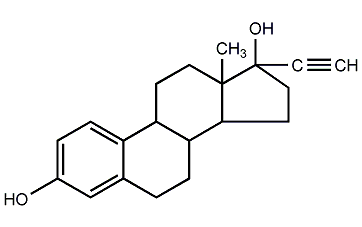
ethinylestradiol

Ethinyl Estradiol Structural Formula

Structural formula

Business number 018U
Molecular formula C20H24O2
Molecular weight 296.41
label

17?-Ethyne-1,3,5-(10)-estrotriene-3,17?-diol,

17?-Ethynyl-1,3,5(10)-estratriene-3,17?-diol

Numbering system

CAS number:57-63-6

MDL number:MFCD00003690

EINECS number:200-342-2

RTECS number:RC8925000

BRN number:2419975

PubChem number:24894585

Physical property data

1. Properties: White to milky white crystalline powder. Odorless.

2. Density (g/mL, 25/4?): 1.1460

3. Relative vapor density (g/mL, air=1): Undetermined

4. Melting point (ºC): 145-146? (hemihydrate). 182-184? (anhydrous)

5. Boiling point (ºC, normal pressure): Undetermined

6. Boiling point (ºC, 5.2kPa): Undetermined

7. Refractive index: Undetermined

8. Flash point (ºC): Undetermined

9. Specific rotation (º): Undetermined

10. Autoignition point or ignition temperature (ºC): Undetermined

11. Vapor pressure (kPa, 25ºC): Undetermined

12. Saturated vapor pressure (kPa, 60ºC): Undetermined

13. Heat of combustion (KJ/mol): Undetermined

14. Critical temperature (ºC): Undetermined

15. Critical pressure (KPa): Undetermined

16. The logarithmic value of the oil-water (octanol/water) partition coefficient: Undetermined

17. Explosion upper limit (%, V/V): Undetermined

18. Lower explosion limit (%, V/V): Undetermined

19. Solubility: Soluble in ethanol??, propanol, ether, chloroform, dioxane, vegetable oil and sodium hydroxide solution are almost insoluble in water.

Toxicological data

None

Ecological data

None

Molecular structure data

1. Molar refractive index: 86.26

2. Molar volume (m3/mol): 244.4

3. Isotonic specific volume (90.2K): 672.4

4. Surface tension (dyne/cm): 57.2

5. Polarizability (10-24cm3): 34.19

Compute chemical data

1. Reference value for calculating hydrophobic parameters (XlogP): 3.7

2. Number of hydrogen bond donors: 2

3. Number of hydrogen bond receptors: 2

4. Number of rotatable chemical bonds: 7

5. Number of tautomers: 9

6. Topological molecular polar surface area (TPSA): 40.5

7. Number of heavy atoms: 22

8. Surface charge: 0

9. Complexity: 505

10. Number of isotope atoms: 0

11. Determine the number of atomic stereocenters: 5

12. Number of uncertain atomic stereocenters: 0

13. Determine the number of stereocenters of chemical bonds: 0

14. Number of uncertain chemical bond stereocenters: 0

15. Number of covalent bond units: 1

Properties and stability

None

Storage method

Stored in inert gas.

Synthesis method

Obtained from the ethynylation of estrone (C18H22O2, [53-16-7]): Heat toluene isobutanol, potassium hydroxide and isobutanol under reflux and azeotropic dehydration for 8 hours, add tetrahydrofuran, and heat at 25-40°C Pour acetylene down to the required amount. Add estrone solution in tetrahydrofuran and continue to pass acetylene at 5-10°C for 12 hours. Use 30% sulfuric acid to adjust the slight acidity below 40°C, and recover tetrahydrofuran under reduced pressure. Remove the residual solution by steam distillation, cool, filter, wash with water until neutral, and dry at 80°C to obtain crude ethinyl estradiol. After recrystallization from ethanol and decolorization of activated carbon, the finished product is obtained. The yield is 85%.

Purpose

This product is an estrogen drug. It has the same effect as diethylstilbestrol, but is 20 times more potent. Used in combination with progestin-based contraceptives, it has a synergistic effect in inhibiting ovulation, can enhance contraceptive efficacy, and can reduce side effects such as breakthrough bleeding. In addition, it can also be used for menstrual disorders such as amenorrhea, oligomenorrhea, menopausal syndrome and uterine hypoplasia. For preparation of contraceptive pills.

extended-reading:https://www.newtopchem.com/archives/44123
extended-reading:https://www.bdmaee.net/wp-content/uploads/2022/08/potassium-acetate-CAS-127-08-2-Potassium.pdf
extended-reading:https://www.newtopchem.com/archives/1859
extended-reading:https://www.newtopchem.com/archives/44564
extended-reading:https://www.newtopchem.com/archives/category/products/page/163
extended-reading:https://www.cyclohexylamine.net/polyurethane-thermal-catalyst-thermal-delayed-catalyst/
extended-reading:https://www.bdmaee.net/pc-cat-np50-catalyst-pentamethyldipropylenetriamine/
extended-reading:https://www.bdmaee.net/dabco-mp601-catalyst-cas1739-84-0-evonik-germany/
extended-reading:https://www.bdmaee.net/fascat-4210-catalyst/
extended-reading:https://www.bdmaee.net/wp-content/uploads/2021/05/2-8.jpg