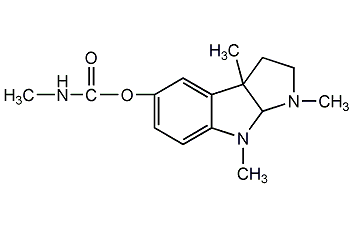
Physostigmine

Physostigmine Structural Formula

Structural formula

Business number 018N
Molecular formula C15H21N3O2
Molecular weight 275.35
label

Eserine

Numbering system

CAS number:57-47-6

MDL number:MFCD00151090

EINECS number:200-332-8

RTECS number:TJ2100000

BRN number:91230

PubChem number:24277867

Physical property data

1. Character: Colorless rhombic prism or flake crystal.


2. Density (g/mL,25/4?): Undetermined


3. Relative vapor density (g/mL,AIR=1): Undetermined


4. Melting point (ºC):105~106? (there are also unstable low-melting point products, as 86?87?)


5. Boiling Point (ºC,Normal pressure): Undetermined


6. Boiling Point (ºC,5.2kPa): Undetermined


7. Refractive Index: Undetermined


8.         Flash Point (ºC ): Undetermined


9. Specific rotation (º):[? ]D17 ?76°?C?1.3, in chloroform), [?]D25 ?120°?C?1, in benzene )


10. Autoignition point or ignition temperature (ºC): Undetermined


11. Vapor pressure (kPa,25ºC): Undetermined


12. saturated vapor pressure (kPa,60ºC): Undetermined


13. Burning Heat (KJ/mol): Undetermined


14. Critical temperature (ºC): Undetermined


15. Critical Pressure (KPa): Undetermined


16. Oil and water (octanol/Log value of partition coefficient for water: undetermined


17. Explosion limit (%,V/V): Undetermined


18. Explosion lower limit (%,V/V): Undetermined


19. Solubility: Soluble in ethanol, benzene, chloroform and oil, slightly soluble in water.

Toxicological data

None

Ecological data

None

Molecular structure data

5. Molecular property data:


1. Molar refractive index: 77.18


2. Molar volume (m3/mol??236.0


3. isotonic specific volume (90.2K):602.3


4. Surface Tension (dyne/cm):42.3


5. Polarizability(10-24cm3): 30.59

Compute chemical data

1. Reference value for hydrophobic parameter calculation (XlogP): None

2. Number of hydrogen bond donors: 1

3. Number of hydrogen bond acceptors: 4

4. Number of rotatable chemical bonds: 2

5. Number of tautomers: 2

6. Topological molecule polar surface area 44.8

7. Number of heavy atoms: 20

8. Surface charge: 0

9. Complexity: 403

10. Number of isotope atoms: 0

11. Determine the number of atomic stereocenters: 2

12. Uncertain number of atomic stereocenters: 0

13. Determine the number of chemical bond stereocenters: 0

14. Number of uncertain chemical bond stereocenters: 0

15. Number of covalent bond units: 1

Properties and stability

None

Storage method

This product should be sealed and stored in a cool, dark place.

Synthesis method

Physostigmine can be extracted from physostigmine seeds and processed with salicylic acid. It can also be synthesized artificially.

Purpose

Biochemical research. It can inhibit cholinesterase and excite smooth muscle and striated muscle. It can narrow pupils and reduce intraocular pressure, and is mainly used for glaucoma. The effect is stronger and more durable than pilocarpine.

extended-reading:https://www.newtopchem.com/archives/category/products/page/162
extended-reading:https://www.newtopchem.com/archives/44468
extended-reading:https://www.newtopchem.com/archives/category/products/page/131
extended-reading:https://www.bdmaee.net/niax-d-22-gel-catalyst-dibutyltin-dilaurate-momentive/
extended-reading:https://www.cyclohexylamine.net/cas-108-01-0-nn-dimethyl-ethanolamine-dmea/
extended-reading:https://www.bdmaee.net/niax-kst-100npf-low-odor-tertiary-amine-catalyst-momentive/
extended-reading:https://www.newtopchem.com/archives/1006
extended-reading:https://www.bdmaee.net/zinc-octoate-2/
extended-reading:https://www.bdmaee.net/foam-delay-catalyst/
extended-reading:https://www.bdmaee.net/cas-2273-43-0-2/
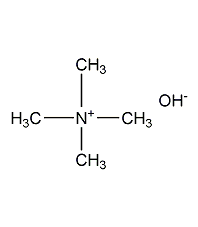
Tetramethylammonium hydroxide

Tetramethylammonium hydroxide structural formula

Structural formula

Business number 01JU
Molecular formula C4H13NO
Molecular weight 91.05
label

N,N,N-Trimethylmethanaminium Hydroxide,

(CH3)4N(OH)

Numbering system

CAS number:75-59-2

MDL number:MFCD00008280

EINECS number:200-882-9

RTECS number:PA0875000

BRN number:3558708

PubChem number:24866695

Physical property data

1. Properties: It has a certain smell of ammonia, is highly alkaline, and easily absorbs CO2 in the air. It is usually made into 10% or 25% aqueous solution. Tetramethylammonium hydroxide containing 5 molecules of crystal water is colorless. Deliquescent needle crystals. When heated to the boiling point, it easily decomposes into trimethylamine and methanol, with a specific gravity of 1.00 (25/4°C).

2. Density (g/mL, 25/4?): 1.016

3. Relative vapor density (g/mL, air=1): Uncertain

4. Melting point (ºC): 62-71°C.

5. Boiling point (ºC, normal pressure): 120?

6. Boiling point (ºC, 5.2kPa): Uncertain

7. Refractive index: 1.3806

8. Flash point (ºC): Uncertain

9. Specific rotation (º): Uncertain

10. Autoignition point or ignition Temperature (ºC): Uncertain

11. Vapor pressure (kPa, 25ºC): Uncertain

12. Saturated vapor pressure (kPa, 60ºC): Uncertain

13. Heat of combustion (KJ/mol): Uncertain

14. Critical temperature (ºC): Uncertain

15. Critical pressure (KPa): Uncertain

16. The logarithmic value of the oil-water (octanol/water) partition coefficient: Uncertain

17. The upper limit of explosion (%, V/V): Uncertain

18. Lower explosion limit (%, V/V): Uncertain

19. Solubility: Soluble in water, ethanol, etc.

Toxicological data

1. Acute toxicity

Mouse subcutaneous LD50: 19mg/kg

Rabbit intravenous LD50: 1mg/kg

Pig skin LD50: 25mg/kg

Frog gastrointestinal LDL0: 5mg/kg

Frog LDL0: 1515 ug/kg

2

Main irritant effects:

On skin: Causes corrosive effects on skin and mucous membranes.

On eyes: Strong corrosive effects

Sensitization: No known sensitizing effects.

Ecological data

General remarks

Water hazard level 1 (German regulations) (self-assessment via list) This substance is slightly hazardous to water.

Do not allow undiluted or large quantities of product to come into contact with groundwater, waterways or sewage systems.

Do not discharge materials into the surrounding environment without government permission.

Hazardous to organic matter in water

?Excessive discharge into rivers and sewers can cause an increase in ph value. Excessively high ph value is harmful to organic matter in the water.

Concentration dilution during use can greatly reduce the ph value, thereby reducing Hazards to water caused by product discharge

Molecular structure data

None

Compute chemical data

1. Reference value for hydrophobic parameter calculation (XlogP): None

2. Number of hydrogen bond donors: 1

3. Number of hydrogen bond acceptors: 1

4. Number of rotatable chemical bonds: 0

5. Number of tautomers: none

6. Topological molecule polar surface area 1

7. Number of heavy atoms: 6

8. Surface charge: 0

9. Complexity: 19.1

10. Number of isotope atoms: 0

11. Determine the number of atomic stereocenters: 0

12. Uncertain number of atomic stereocenters: 0

13. Determine the number of chemical bond stereocenters: 0

14. Number of uncertain chemical bond stereocenters: 0

15. Number of covalent bond units: 2

Properties and stability

None

Storage method

This product should be sealed and stored in a cool, dry place away from light.                                                                      

Synthesis method

None

Purpose

In terms of silicone, it can be used as catalysts for dimethyl silicone oil, benzyl silicone oil, silicone diffusion pump oil, solvent-free silicone molding compound, silicone resin, silicone rubber, etc. In terms of analysis, it is used as a polarographic reagent and in product purification as an ashless alkali to precipitate many metal elements. In the production of organic silicon wafers, it is often used as a brightener, cleaning agent and contact agent for computer silicon wafer surfaces. This product is a catalyst in organosilicon polymerization. Its advantages are: it is strongly alkaline and stable at temperatures that do not exceed the decomposition point. When it exceeds the decomposition point, it quickly decomposes into trimethylamine and methanol. When the catalysis is completed, it is easy to remove without leaving any residue. No pollution to silicone products. Therefore, it is also called a “temporary catalyst”. It can be used in polarographic tests and to precipitate hydrides of many elements that do not contain ash.

extended-reading:https://www.cyclohexylamine.net/soft-foam-amine-catalyst-b16-hard-foam-amine-catalyst-b16/
extended-reading:https://www.newtopchem.com/archives/category/products/page/25
extended-reading:https://www.newtopchem.com/archives/44061
extended-reading:https://www.cyclohexylamine.net/semi-hard-foam-catalyst-tmr-3-hard-foam-catalyst-tmr-3/
extended-reading:https://www.newtopchem.com/archives/40475
extended-reading:https://www.newtopchem.com/archives/44076
extended-reading:https://www.bdmaee.net/lupragen-n100-catalyst-basf/
extended-reading:https://www.newtopchem.com/archives/44759
extended-reading:https://www.morpholine.org/category/morpholine/page/9/
extended-reading:https://www.newtopchem.com/archives/category/products/page/147

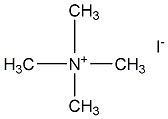
Tetramethylammonium iodide

Tetramethylammonium iodide structural formula

Structural formula

Business number 01JT
Molecular formula C4H12IN
Molecular weight 201.05
label

Tetramethyliodide,

Tetramethylamine iodide,

Tetramethyliodide,

(CH3)4N(I)

Numbering system

CAS number:75-58-1

MDL number:MFCD00011629

EINECS number:200-881-3

RTECS number:PA1050000

BRN number:3620030

PubChem number:24854126

Physical property data

1. Properties: This product is light yellow crystal and hygroscopic.


2. Density (g/mL,25/4?)?1.84


3. Relative vapor density (g/mL ,Air=1): Unsure


4. Melting point (ºC): 300 °C.


5. Boiling point (ºC,Normal pressure):230


6. Boiling point (ºC,5.2kPa): Unsure


7. Refractive index: Uncertain


8. Flash Point (ºC): Unsure


9. Specific optical rotation (º): Unsure


10. Autoignition point or ignition temperature (ºC): Unsure


11. Vapor pressure (kPa,25ºC): Unsure


12. ?? and vapor pressure (kPa,60ºC): Unsure


13. Heat of combustion (KJ/mol): Unsure


14. Critical temperature (ºC): Unsure


15. Critical pressure (KPa): Unsure


16. Oil and water (octanol/Logarial value of partition coefficient for water: Uncertain


17.Explosion limit (%,V/V): Unsure


18. Lower explosion limit (%,V/V): Unsure


19. Solubility: Easily soluble in anhydrous ethanol, slightly soluble in water, insoluble in ether and chloroform.


Toxicological data

1, acute toxicity


?Mouse abdominal cavityLD50: 3560 ug/kg


?Mouse abdominal cavityLD50:30mg/kg


smallMouse subcutaneousLD50:33mg/kg


?Mouse veinLD50:180 ug/kg

Ecological data

None

Molecular structure data

None

Compute chemical data

1. Reference value for hydrophobic parameter calculation (XlogP): None

2. Number of hydrogen bond donors: 0

3. Number of hydrogen bond acceptors: 1

4. Number of rotatable chemical bonds: 0

5. Number of tautomers: none

6. Topological molecule polar surface area 0

7. Number of heavy atoms: 6

8. Surface charge: 0

9. Complexity: 19.1

10. Number of isotope atoms: 0

11. Determine the number of atomic stereocenters: 0

12. Uncertain number of atomic stereocenters: 0

13. Determine the number of chemical bond stereocenters: 0

14. Number of uncertain chemical bond stereocenters: 0

15. Number of covalent bond units: 2

Properties and stability

None

Storage method

This product should be sealed and stored in a cool, dry place away from light.

Synthesis method

None

Purpose

Polarographic analysis, determination of germanium. Used as phase transfer catalyst.

extended-reading:https://www.newtopchem.com/archives/category/products/page/65
extended-reading:https://www.cyclohexylamine.net/category/product/page/17/
extended-reading:https://www.cyclohexylamine.net/low-odor-polyurethane-catalyst-polyurethane-rigid-foam-catalyst/
extended-reading:https://www.newtopchem.com/archives/44319
extended-reading:https://www.bdmaee.net/niax-c-41-liquid-tertiary-amine-catalyst-momentive/
extended-reading:https://www.bdmaee.net/polycat-41-catalyst-cas10294-43-5-evonik-germany/
extended-reading:https://www.newtopchem.com/archives/39793
extended-reading:https://www.bdmaee.net/nt-cat-mb20-catalyst-cas-68007-43-3-newtopchem/
extended-reading:https://www.bdmaee.net/n-ethylmorpholine/
extended-reading:https://www.cyclohexylamine.net/metal-catalyst-heat-sensitive-metal-catalyst/