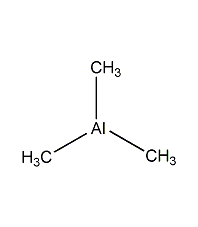
Trimethylaluminum

Trimethylaluminum structural formula

Structural formula

Business number 01J9
Molecular formula C3H9Al
Molecular weight 72.09
label

Aluminum trimethanide,

TMA,

High purity substances and reagents,

Electronic specialty gas raw materials and intermediates

Numbering system

CAS number:75-24-1

MDL number:MFCD00008252

EINECS number:200-853-0

RTECS number:BD2204000

BRN number:3587197

PubChem number:24855575

Physical property data

1. Properties: colorless liquid

2. Density (g/mL, 20?): 0.688

3. Relative vapor density (g/mL, air=1 ): Undetermined

4. Melting point (ºC): 15

5. Boiling point (ºC, normal pressure): 126

6. Boiling point (ºC, 5.2kPa): Not determined

7. Refractive index: Not determined

8. Flash point (ºF): 40

9. Specific rotation (º ): Undetermined

10. Autoignition point or ignition temperature (ºC): -22

11. Vapor pressure (kPa, 25ºC): Undetermined

12. Saturated vapor pressure (kPa, 60ºC) not determined:

13. Heat of combustion (KJ/mol): not determined

14. Critical temperature (ºC): not determined

15. Critical pressure (KPa): Undetermined

16. Log value of oil-water (octanol/water) partition coefficient: Undetermined

17. Explosion upper limit (%, V/V): 1.1

18. Explosion lower limit (%, V/V): 7.5

19. Solubility: reacts strongly with water

Toxicological data

Harmful if ingested, inhaled or absorbed through the skin. It has a strong irritating effect on eyes, skin and mucous membranes. Inhaling smoke particles can cause replacement of blood proteins, leading to a hyperthermia reaction.

Ecological data

It is extremely harmful to water, even in small amounts, it is toxic to fish and plankton in water bodies.

Toxic to organic matter in water.

Molecular structure data

None yet

Compute chemical data

1. Reference value for hydrophobic parameter calculation (XlogP): None

2. Number of hydrogen bond donors: 0

3. Number of hydrogen bond acceptors: 0

4. Number of rotatable chemical bonds: 0

5. Number of tautomers: none

6. Topological molecule polar surface area 0

7. Number of heavy atoms: 4

8. Surface charge: 0

9. Complexity: 8

10. Number of isotope atoms: 0

11. Determined number of atomic stereocenters: 0

12. Uncertain number of atomic stereocenters: 0

13. Determine the number of stereocenters of chemical bonds: 0

14. Uncertain number of stereocenters of chemical bonds: 0

15. Number of covalent bond units: 1

Properties and stability

Decomposes with moisture, air, oxides, alcohols, halocarbons, acids, bases, halides, ammonia and amines.

Storage method

Seal and store in a cool, dry, ventilated place, anti-static.

Store away from water, heat, halocarbons, alcohol, and amines.

Avoid contact with air and water.

Synthesis method

1. This product can be produced by heating metallic aluminum and dimethylmercury; or by producing trihalotrimethyldisaluminum from metallic aluminum and halogenated methane, and then reacting with metallic sodium.

2.Use Zn, EtBr and EtI to react in the presence of Cu salt and catalyst to generate EtZnX (X=Br, I), heat it to It is converted into diethyl zinc, which can be separated and purified by distillation.

3.Aluminum powder reacts with methyl iodide to form methylaluminum iodide, which is alloyed with potassium and sodium in dry decane liquid The reaction produces crude trimethylaluminum. The mixture of crude trimethylaluminum and decane is distilled under reduced pressure or normal pressure to obtain a high purity product.

Purpose

1. Trimethylaluminum is used as an olefin polymerization catalyst and ignition fuel. It is also used to prepare linear primary alcohols and olefins. It can be used for vapor deposition of metal organic compounds.

2.Used as P-type of AsGa, GaP and GaAsP when manufacturing light-emitting diodes Dopants. It is also a raw material for the MOCVD process and is used to deposit zinc films.

3.High-purity trimethylaluminum is used as a raw material for the MOCVD process to deposit aluminum films. It can also be used as a catalyst for olefin polymerization.

extended-reading:https://www.bdmaee.net/niax-a-30-foaming-catalyst-momentive/
extended-reading:https://www.morpholine.org/dimethomorph/
extended-reading:https://www.newtopchem.com/archives/category/products/page/5
extended-reading:https://www.newtopchem.com/archives/43957
extended-reading:https://www.bdmaee.net/wp-content/uploads/2022/08/115.jpg
extended-reading:https://www.morpholine.org/polyurethane-catalyst-1028/
extended-reading:https://www.bdmaee.net/dabco-xd-102-dabco-amine-catalyst-amine-catalyst/
extended-reading:https://www.newtopchem.com/archives/44365
extended-reading:https://www.newtopchem.com/archives/44919
extended-reading:https://www.newtopchem.com/archives/1120
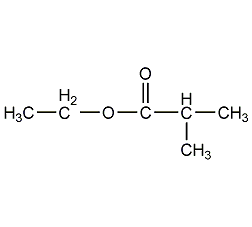
Ethyl isobutyrate

Ethyl isobutyrate structural formula

Structural formula

Business number 02CF
Molecular formula C6H12O2
Molecular weight 116.16
label

2-Methylpropionate,

Ethyl 2-methyl propane,

(CH3)2CHCOOCH2CH3,

spices

Numbering system

CAS number:97-62-1

MDL number:MFCD00009165

EINECS number:202-595-4

RTECS number:NQ4675000

BRN number:773846

PubChem number:24881085

Physical property data

1. Properties: Colorless and volatile liquid with fruity aroma. [1]

2. Melting point (?): -88[2]

3. Boiling point (?): 110.1[3]

4. Relative density (water = 1): 0.87[4]

5. Relative vapor Density (air=1): 4.01[5]

6. Saturated vapor pressure (kPa): 5.33 (33.8?)[6]

7. Heat of combustion (kJ/mol): -3535.0[7]

8. Critical temperature (?): 280[8]

9. Critical pressure (MPa): 3.04[9]

10. Octanol/water partition coefficient: 1.77 [10]

11. Flash point (?): 13[11]

12. Solubility: slightly soluble in water, Soluble in ethanol, ether, etc. [12]

13. Refractive index (n20ºC): 1.3869

14. Solubility parameter (J·cm-3)0.5: 16.504

15. Critical density (g·cm-3): 0.28

16. Critical volume (cm3·mol-1): 415

17. Critical compression factor: 0.279

18. Eccentricity factor: 0.426

19.van der Waals Volume (cm3·mol-1): 73.200

20.van der Waals Area (cm2·mol-1): 1.050×10¹⁰

21. Liquid phase standard hot melt ( J·mol-1·K-1)?209.8

Toxicological data

1. Acute toxicity[13] LD50: 800mg/kg (mouse vein); 800mg/kg (mouse abdominal cavity)

2. Irritation [14] Rabbit transdermal: 500mg (24h), moderate irritation.

Ecological data

1. Ecotoxicity No data available

2. Biodegradability No data available

3 .Non-biodegradability No data yet

4. Other harmful effects[15] This substance may be harmful to the environment and is harmful to the environment. Bodies of water should be given special attention.

Molecular structure data

1. Molar refractive index: 31.57

2. Molar volume (cm3/mol): 131.4

3. Isotonic specific volume (90.2K ): 292.9

4. Surface tension (dyne/cm): 24.6

5. Dielectric constant:

6. Dipole moment (10-24cm3):

7. Polarizability: 12.51

Compute chemical data

1. Hydrophobic parameter calculation parameters?? value (XlogP): 1.5

2. Number of hydrogen bond donors: 0

3. Number of hydrogen bond acceptors: 2

4. Yes Number of rotational chemical bonds: 3

5. Number of tautomers: None

6. Topological molecule polar surface area 26.3

7. Number of heavy atoms: 8

8. Surface charge: 0

9. Complexity: 76.6

10. Number of isotope atoms: 0

11. Determine the number of atomic stereocenters: 0

12. Uncertain number of atomic stereocenters: 0

13. Determine the number of chemical bond stereocenters: 0

14. Number of uncertain chemical bond stereocenters: 0

15. Number of covalent bond units: 1

Properties and stability

1. Stability[16] Stable

2. Incompatible substances[17] Strong oxidants, strong bases, strong acids

3. Polymerization hazard[18] No polymerization

Storage method

Storage Precautions[19] Stored in a cool, ventilated warehouse. Keep away from fire and heat sources. The storage temperature should not exceed 37?. Keep container tightly sealed. They should be stored separately from oxidants, acids, and alkalis, and avoid mixed storage. Use explosion-proof lighting and ventilation facilities. It is prohibited to use mechanical equipment and tools that are prone to sparks. The storage area should be equipped with emergency release equipment and suitable containment materials.

Synthesis method

1. Obtained from the esterification of isobutyric acid and absolute ethanol. After mixing isobutyric acid and absolute ethanol, carefully add concentrated sulfuric acid, heat to reflux for 14 hours, wash with water, saturated sodium bicarbonate solution, and water in sequence, dry over anhydrous magnesium sulfate, distill, and collect 109-111°C Fraction, 2-methylpropionic acid ethyl ester was obtained with a yield of 69%.

2. It is obtained by heating esterification of isobutyric acid and ethanol under azeotropic conditions and then distilling it.

Purpose

Used in organic synthesis, essence extraction, etc. [20]

extended-reading:https://www.bdmaee.net/wp-content/uploads/2022/08/-33-LX–33-LX-catalyst-tertiary-amine-catalyst-33-LX.pdf
extended-reading:https://www.bdmaee.net/fomrez-ul-28-catalyst-dimethyltin-dioctadecanoate-momentive-2/
extended-reading:https://www.newtopchem.com/archives/927
extended-reading:https://www.newtopchem.com/archives/44551
extended-reading:https://www.bdmaee.net/wp-content/uploads/2022/08/stannous-octoate-CAS-301-10-0–T-9.pdf
extended-reading:https://www.morpholine.org/teda-l33b-dabco-polycat-gel-catalyst/
extended-reading:https://www.cyclohexylamine.net/polyurethane-monosodium-glutamate-self-skinning-pinhole-elimination-agent/
extended-reading:https://www.newtopchem.com/archives/39408
extended-reading:https://www.bdmaee.net/catalyst-pt303/
extended-reading:https://www.newtopchem.com/archives/1850

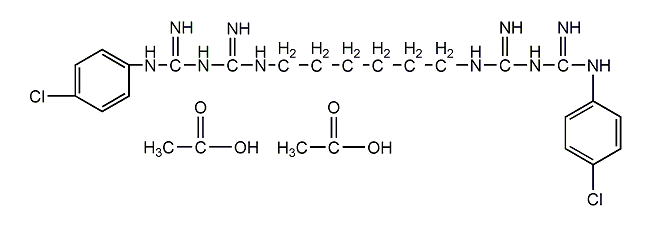
Chlorhexidine diacetate

Chlorhexidine diacetate structural formula

Structural formula

Business number 0187
Molecular formula C22H30Cl2N10·2C2H4O2
Molecular weight 625.6
label

1,6-Bis(N5-[p-chlorophenyl]-N1-biguanido)hexane,

1,1?-Hexamethylenebis(5-[p-chlorophenyl]biguanide),

Chlorhexidine acetate,

Chlorhexidine acetate

Numbering system

CAS number:56-95-1

MDL number:MFCD00012532

EINECS number:200-302-4

RTECS number:DU1930000

BRN number:None

PubChem number:24892838

Physical property data

1. Characteristics: white crystal sex powder.


2. Density (g/mL,25/4?) ? Undetermined


3. Relative vapor density (g/mL, Air=1): Undetermined


4. Melting point (ºC): 260-262? decomposition


5. Boiling point (ºC,Normal pressure): Undetermined


6. Boiling point (ºC,5.2kPa): Undetermined


7. Refractive Index: Undetermined


8. Flashpoint (ºC): Undetermined


9. Specific optical rotation ( º): Undetermined


10. Spontaneous ignition point or ignition Combustion temperature (ºC): not OK


11. Vapor Pressure (kPa,25ºC): Undetermined


12. Saturated vapor pressure ( kPa,60ºC): Undetermined


13. Heat of combustion (KJ/mol): Undetermined


14. Critical temperature (ºC): Undetermined


15. Critical Pressure (KPa): Undetermined


16. Oil and water (octanol /Water) partition coefficient pair Value: Undetermined


17. Explosion upper limit (%,V/V): Undetermined


18. Lower explosion limit (%,V/V): not OK

19.Solubility:20?The solubility in water is1.9g/100ml, soluble in ethanol.

Toxicological data

1, Skin or Eye Irritation: Rabbit, Skin Contact, Standard Draize test test, 500mg/24H
2, acute toxicity:; mouse Oral LD50: 2mg/kg; mouse abdominal cavity LD50: 38mg/kg; mouse subcutaneous LD50: 325mg/kg; mouse intravenous LD50: 25mg/kg

Ecological data

None yet

Molecular structure data

None yet

Compute chemical data

1. Reference value for hydrophobic parameter calculation (XlogP): None

2. Number of hydrogen bond donors: 8

3. Number of hydrogen bond acceptors: 6

4. Number of rotatable chemical bonds: 13

5. Number of tautomers: 36

6. Topological molecular polar surface area 252

7. Number of heavy atoms: 42

8. Surface charge: 0

9. Complexity: 680

10. Number of isotope atoms: 0

11. Determine the number of atomic stereocenters: 0

12.The number of uncertain atomic stereocenters: 0

13. The number of determined chemical bond stereocenters: 2

14. The uncertain number of chemical bond stereocenters: 0

15. Number of covalent bond units: 3

Properties and stability

None yet

Storage method

This product should be sealed and stored in a dry and dark place.

Synthesis method

It is prepared from p-chloroaniline through diazotization, condensation, elimination of denitrification, condensation, and neutralization to form a salt.

Purpose

Disinfectants. It has a strong bactericidal effect on Gram-positive bacteria, negative bacteria and fungi, and is also effective on Pseudomonas aeruginosa. Used for skin disinfection, wound irrigation, and surgical instrument disinfection.

extended-reading:https://www.cyclohexylamine.net/dabco-ne1070-gel-type-low-odor-catalyst/
extended-reading:https://www.morpholine.org/category/morpholine/dimethomorph/
extended-reading:https://www.newtopchem.com/archives/44159
extended-reading:https://www.newtopchem.com/archives/45010
extended-reading:https://www.bdmaee.net/cas-3855-32-1/
extended-reading:https://www.cyclohexylamine.net/category/product/page/13/
extended-reading:https://www.bdmaee.net/jeffcat-td-33a-catalyst-cas107-16-9-huntsman/
extended-reading:https://www.bdmaee.net/pc-cat-np70-catalyst-nn-dimethylethylaminoethylene-glycol/
extended-reading:https://www.bdmaee.net/nt-cat-pt1003/
extended-reading:https://www.bdmaee.net/pc5-catalyst/