Eugenol

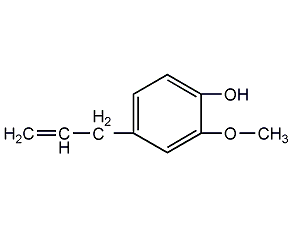
eugenol structural formula

Structural formula

Business number 02CA
Molecular formula C10H12O2
Molecular weight 164.2
label

eugenol,

4-allyl-2-methoxyphenol,

1-Hydroxy-2-methoxy-4-allylbenzene,

4-allylguaiacol,

4-Allyl-2-methoxyphenol,

artificial flavors

Numbering system

CAS number:97-53-0

MDL number:MFCD00008654

EINECS number:202-589-1

RTECS number:SJ4375000

BRN number:1366759

PubChem number:24862128

Physical property data

1. Properties: Colorless or light yellow liquid, the color deepens when exposed to the air or under strong light. There is a strong clove aroma.

2. Melting point (ºC): -9.2~-9.1

3. Boiling point (ºC): 253.2

4. Relative density (20?, 4 ?): 1.0672

5. Relative density (25?, 4?): 1.065220

6. Refractive index at room temperature (n20 ): 1.5405

7. Refractive index at room temperature (n25): 1.534530

8. Dissolution Properties: Slightly soluble in water, soluble in ethanol, acetone, ethyl acetate, ether, chloroform and other organic solvents.

9.Flash point (?): >110

Toxicological data

Toxicity classification Poisoning

Acute toxicity: Oral – Rat LD50: 1930 mg/kg; Oral – Mouse LC50: 3000 mg/kg.

Irritation Data: Skin – Rabbit 100 mg/24 hours Severe.

Ecological data

This substance is slightly hazardous to water.

Molecular structure data

1. Molar refractive index: 48.72

2. Molar volume (cm3/mol): 156.2

3. Isotonic specific volume (90.2K ): 384.3

4. Surface tension (dyne/cm): 36.5

5. Dielectric constant:

6. Dipole moment (10-24cm3):

7. Polarizability: 19.31

Compute chemical data

1. Reference value for hydrophobic parameter calculation (XlogP): None

2. Number of hydrogen bond donors: 1

3. Number of hydrogen bond acceptors: 2

4. Number of rotatable chemical bonds: 3

5. Number of tautomers: 3

6. Topological molecule polar surface area 29.5

7. Number of heavy atoms: 12

8. Surface charge: 0

9. Complexity: 145

10. Number of isotope atoms: 0

11. Determine the number of atomic stereocenters: 0

12. Uncertain number of atomic stereocenters: 0

13. Determine the number of chemical bond stereocenters: 0

14. Number of uncertain chemical bond stereocenters: 0

15. Number of covalent bond units: 1

Properties and stability

1. Avoid contact with oxides.

2. Colorless to light yellow liquid. Rich caramel sweet aroma. The color turns brown and black after being stored for a long time and exposed to air.

3. Exist in oriental tobacco leaves and smoke.

4. Found in clove oil, cinnamon leaf oil, cinnamon bark oil, camphor oil, nutmeg oil, etc.

Storage method

Brown glass bottle with light-sealed packaging. Store in a cool and dark place.

Synthesis method

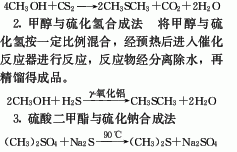
1. Eugenol mainly exists in clove basil oil and camphor cinnamon leaf oil. It is a component of various aromatic oils, especially clove oil, cinnamon leaf oil, basil oil, and laurel oil. Although eugenol can also be prepared by synthetic methods, it is generally isolated and extracted from plants or aromatic oils in industry.
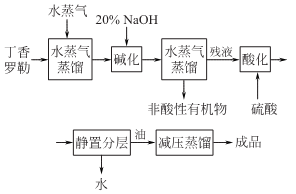
Take the clove basil and remove the fine roots and Foreign matter, dried and chopped, steam distilled. When distilling, maintain a strong fire and return the distillate to the pot to increase the oil yield. When the final steamed oil-water mixture is around 45°C, the relative density of the essential oil is close to water, and the distillate is white and turbid; when the temperature is between 30 and 40°C, part of the oil floats on the water (the relative density of ocimene is about 0.9) , the other part of the oil sinks underwater (the relative density of eugenol is greater than that of water).

Add 20% sodium hydroxide to the oil-water mixture, and then perform steam distillation to remove all non-acidic substances to obtain a eugenol sodium salt solution. Then add 30% sulfuric acid to neutralize it to pH=2~3 (water layer) with stirring at 50°C, let it stand and separate into layers, take off the crude eugenol oil in the lower layer and conduct distillation under reduced pressure to obtain eugenol.

It is produced by the reaction of o-methoxyphenol and allyl bromide, followed by heating and rearrangement.

2.Isolation method: Add excess sodium hydroxide aqueous solution to the natural essential oil containing eugenol, stir thoroughly, and This generates sodium eugenol that is soluble in water. After the oil layer is separated, the alkaline aqueous solution containing sodium eugenol is acidified with dilute sulfuric acid, and the eugenol is re-precipitated. Separate the eugenol oil layer, wash and dry it, and then distill it under reduced pressure to obtain refined eugenol.

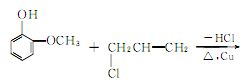
3.The synthesis method uses o-methoxyphenol and allyl chloride as raw materials, in the presence of metallic copper, Heating to about 100?, eugenol can be generated in one step. Since the boiling points of the three isomers are very close, the separation and purification work is very complicated. Therefore, the isolation method to generate eugenol is still the main method at present.

4. Tobacco: OR, 26; can be separated from clove oil. When the synthetic method uses guaiacol as raw material to prepare eugenol, there are many side reactions, and it is difficult to separate and purify.

Purpose

1. In addition to being used in medicine, it can also be used as a raw material for synthetic fragrances. It can also be used to prepare carnation-flavored daily flavors and can also be used as edible spices.

2.Mainly used for preparing mint, nuts, spicy foods and tobacco flavors. The dosage used in meat is 40~2000mg/kg; in gum, 500mg /kg; in condiments, 9.6~100mg/kg; in baked goods, 33mg/kg; 32 in candiesmg/kg; 3.1 in cold drinks mg/kg; 1.4mg/kg in soft drinks; 0.6 in puddings. In addition, eugenol has antiseptic and strong bactericidal properties and is found naturally in many essential oils.

3.Eugenol is the main fragrance agent for preparing clove, carnation, carnation and other flavors. It is used for preparing woody and oriental flavors. Fixatives and modifiers for fragrances. It is also often used in mint, nuts, spicy food flavors and tobacco flavors, and is also an important raw material for the synthesis of vanillin. It is also used in medicine and oral hygiene products. Eugenol is a commonly used analgesic drug in dentistry. It mainly anesthetizes dental nerves, slows down stimulation and plays an analgesic effect.

4. It is used in the blending of cosmetics, soaps, food and other flavors. Used in the ink industry as an anti-drying agent.

5. Also used as insecticide and preservative.

extended-reading:https://www.newtopchem.com/archives/45087
extended-reading:https://www.morpholine.org/nn-dicyclohexylmethylamine/
extended-reading:https://www.newtopchem.com/archives/39514
extended-reading:https://www.newtopchem.com/archives/862
extended-reading:https://www.newtopchem.com/archives/category/products/page/26
extended-reading:https://www.newtopchem.com/archives/1885
extended-reading:https://www.bdmaee.net/cas-3542-36-7/
extended-reading:https://www.morpholine.org/category/morpholine/
extended-reading:https://www.bdmaee.net/pentamethyldipropene-triamine-2/
extended-reading:https://www.newtopchem.com/archives/40413
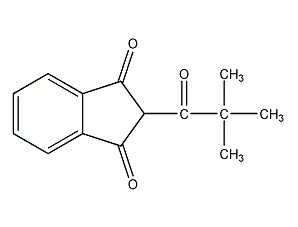
rodentin

Raticide Structural Formula

Structural formula

Business number 01TJ
Molecular formula C14H14O3
Molecular weight 230.26
label

2-Pivaloyl-1,3-indandione,

The rat is over,

rodentin,

pintone,

2-(2,2-Dimethyl-1-oxopropyl)-1H-indene-1,3-(2H)dione,

Pival,

Pivalyl,

Pivacin,

,Pivaldion,

Pivalyn,

2-(2,2-Dimethyl-1-oxopropyl)-1H-indene-1,3-(2H)dione,

Rodenticide

Numbering system

CAS number:83-26-1

MDL number:MFCD00021230

EINECS number:201-462-8

RTECS number:NK6300000

BRN number:2051258

PubChem number:24899309

Physical property data

1. Character: bright yellow crystal

2. Density (g/mL, 25/4?): Uncertain

3. &nb

Toxicological data

None

Ecological data

None

Molecular structure data

1. Molar refractive index: 61.75

2. Molar volume (cm3/mol): 192.3

3. Isotonic specific volume (90.2K ): 502.6

4. Surface tension (dyne/cm): 46.6

5. Polarizability (10-24cm3): 24.48

Compute chemical data

1. Reference value for hydrophobic parameter calculation (XlogP): 2.7

2. Number of hydrogen bond donors: 0

3. Number of hydrogen bond acceptors: 3

4. Number of rotatable chemical bonds: 2

5. Number of tautomers: 3

6. Topological molecule polar surface area 51.2

7. Number of heavy atoms: 17

8. Surface charge: 0

9. Complexity: 351

10. Number of isotope atoms: 0

11. Determine the number of atomic stereocenters: 0

12. Uncertain number of atomic stereocenters: 0

13. Determine the number of chemical bond stereocenters: 0

14. Number of uncertain chemical bond stereocenters: 0

15. Number of covalent bond units: 1

Properties and stability

None

Storage method

None

Synthesis method

None

Purpose

None

extended-reading:https://www.bdmaee.net/wp-content/uploads/2022/08/stannous-octoate-CAS-301-10-0–T-9.pdf
extended-reading:https://www.bdmaee.net/catalyst-pt303-pt303-polyurethane-catalyst-pt303/
extended-reading:https://www.cyclohexylamine.net/cas-3164-85-0-k-15-k-15-catalyst/
extended-reading:https://www.bdmaee.net/wp-content/uploads/2022/08/-tmr-3-TMR-3-catalyst-?TMR.pdf
extended-reading:https://www.newtopchem.com/archives/43923
extended-reading:https://www.bdmaee.net/cas-683-18-1/
extended-reading:https://www.cyclohexylamine.net/category/product/page/25/
extended-reading:https://www.newtopchem.com/archives/44076
extended-reading:https://www.newtopchem.com/archives/44402
extended-reading:https://www.bdmaee.net/toyocat-dmi-gel-catalyst-tosoh/

Methyl sulfide

Methyl sulfide structural formula

Structural formula

Business number 01J5
Molecular formula C2H6S
Molecular weight 62.13
label

dimethyl sulfide,

dimethyl sulfide,

DMS,

Dimethyl sulfide,

2-Thiapropane,

Methyl sulphide,

City gas smell tester,

industrial purifier,

paint release agent,

Battery low temperature preservative,

pesticide penetrant

Numbering system

CAS number:75-18-3

MDL number:MFCD00008562

EINECS number:200-846-2

RTECS number:PV5075000

BRN number:1696847

PubChem number:24856582

Physical property data

1. Properties: colorless liquid with unpleasant odor. [1]

2. Melting point (?): -98.3[2]

3. Boiling point (?): 37.3[3]

4. Relative density (water = 1): 0.85[4]

5. Relative vapor Density (air=1): 2.14[5]

6. Saturated vapor pressure (kPa): 53.2 (20?)[6]

7. Heat of combustion (kJ/mol): -1907.7[7]

8. Critical temperature (?): 229[8]

9. Critical pressure (MPa): 5.69[9]

10. Octanol/water partition coefficient: 0.92 [10]

11. Flash point (?): <-17.7[11]

12. Ignition temperature (?) ?206[12]

13. Explosion upper limit (%): 19.7[13]

14. Explosion lower limit (%) %): 2.2[14]

15. Solubility: Insoluble in water, soluble in most organic solvents such as ethanol and ether. [15]

16. Viscosity (mPa·s, 20ºC): 0.289

17. Viscosity (mPa·s, 25ºC): 0.279

18. Ignition point (ºC): 206.1

19. Heat of evaporation (KJ/mol, 25ºC): 27.61

20. Heat of evaporation (KJ/mol, b.p. ): 27.0174

21. Heat of fusion (KJ/mol): 7.990

22. Heat of formation (KJ/mol, 25ºC): -65.48

23 .Specific heat capacity (KJ/(kg·K), 25ºC, constant pressure): 1.17

24. Boiling point rising constant: 1.85

Toxicological data

1. Acute toxicity:

Rat caliber LD50: 3300mg/kg; rat inhalation LCLO: 40250ppm;

Mouse caliber LD50: 3700mg/kg; mouse inhalation LCLO: 31620 ug/m3;

Mouse abdominal cavity LD50: 8mg/kg; Rabbit skin LD50: >5mg/kg;

Mammal LD50: 1950mg/kg;

2. Other multiple dose toxicity data:

Rat caliber TDLO: 21mg/kg/70D-I; Rabbit caliber TDLO: 24500mg/kg/14W-I;

3. Acute toxicity[16]

LD50: 535mg/kg (rat oral)

LC50: 102235mg /m3(rat inhalation)

4. Irritation[17]

Rabbit transdermal: 500mg (24h),Mild irritation.

Rabbit eye: 259?g (24h), severe irritation.

Ecological data

1. Ecotoxicity[18] LC50: 7.5~15ppm (fish)

2. Biodegradability No data yet

3. Non-biodegradability[19] In the air, when the hydroxyl radical concentration is 5.00×10 At 5pcs/cm3, the degradation half-life is 3.5d (theoretical).

The half-life of photooxidation is 8 hours.

Molecular structure data

1. Molar refractive index: 19.31

2. Molar volume (cm3/mol): 75.5

3. Isotonic specific volume (90.2K ): 162.3

4. Surface tension (dyne/cm): 21.3

5. Polarizability (10-24cm3): 7.65

Compute chemical data

1. Reference value for hydrophobic parameter calculation (XlogP): 0.9

2. Number of hydrogen bond donors: 0

3. Number of hydrogen bond acceptors: 1

4. Number of rotatable chemical bonds: 0

5. Number of tautomers: none

6. Topological molecule polar surface area 25.3

7. Number of heavy atoms: 3

8. Surface charge: 0

9. Complexity: 2.8

10. Number of isotope atoms: 0

11. Determine the number of atomic stereocenters: 0

12. Uncertain number of atomic stereocenters: 0

13. Determine the number of chemical bond stereocenters: 0

14. Number of uncertain chemical bond stereocenters: 0

15. Number of covalent bond units: 1

Properties and stability

1. Chemical properties: It can form addition compounds with halogens, metal halides, etc. Or react with alkyl halides to form sulfonium compounds. When oxidized, sulfoxide is generated, and continued oxidation generates sulfone. It is easy to burn and explode when exposed to open flames or high heat. Thermal decomposition produces toxic sulfide fumes.

2. This product is poisonous. Low-concentration dimethyl sulfide vapor generally causes nausea and loss of appetite, while high-concentration vapor has a paralyzing effect on the central nervous system. During the production process, it must be sealed to prevent running, popping, dripping and leaking. Ventilation should be strengthened at the production site, and operators should wear protective equipment. In the event of poisoning, you should move to a place with fresh air and seek medical treatment.

3. Stability[20] Stable

4. Incompatible substances[21] Strong oxidants, alkalis, ammonia

5. Conditions to avoid contact [22] Heat

6. Polymerization hazard[23] No polymerization

7. Decomposition products[24] Sulfide

Storage method

Storage Precautions[25] Stored in a cool, ventilated warehouse. Keep away from fire and heat sources. The storage temperature should not exceed 29°C. The packaging must be sealed and must not come into contact with air. They should be stored separately from oxidants, alkalis, and ammonia, and avoid mixed storage. Use explosion-proof lighting and ventilation facilities. It is prohibited to use mechanical equipment and tools that are prone to sparks. The storage area should be equipped with emergency release equipment and suitable containment materials.

Synthesis method

1. Refining method: Use the complex formed between mercuric chloride and methyl sulfide for refining: add 1 mol of mercuric chloride to 1250 mL of ethanol, and then add 0.67 mol of methyl sulfide alcohol solution to this solution. The resulting solid is recrystallized to obtain complex crystals with a certain melting point and a structure of 2(CH3)2S·HgCl2. Dissolve 250 mL of concentrated hydrochloric acid in 780 mL of water, add 500 g of the refined complex, and heat to separate the methyl sulfide. After washing with water and drying with calcium chloride, the purity can reach 99.995% (mol).

Purpose

1. This product is a solvent and an intermediate for the production of dimethyl sulfoxide, methionine and pesticides. It can be used as a solvent for organic compounds, resins, inorganic compounds, polymerization reactions and cyanide reactions. Used as analytical reagent, polyacrylonitrile and other synthetic fiber spinning and hydraulic oil. It can also be used as an odorant for city gas, an industrial purifier, a paint release agent, a low-temperature preservative for batteries, a pesticide penetrant, etc. Used topically in hematological medicines, phytopathology and nutrition.

2. Used as solvent and catalyst for most inorganic substances. [26]

extended-reading:https://www.newtopchem.com/archives/44879
extended-reading:https://www.bdmaee.net/dabco-nem-niax-nem-jeffcat-nem/
extended-reading:https://www.morpholine.org/bismuth-2-ethylhexanoate/
extended-reading:https://www.morpholine.org/category/morpholine/page/3/
extended-reading:https://www.bdmaee.net/fascat4102-catalyst-monobutyl-tin-triisooctanoate-cas-23850-94-4/
extended-reading:https://www.newtopchem.com/archives/966
extended-reading:https://www.bdmaee.net/pc-cat-td33eg-catalyst/
extended-reading:https://www.bdmaee.net/spraying-composite-amine-catalyst/
extended-reading:https://www.newtopchem.com/archives/44080
extended-reading:https://www.newtopchem.com/archives/44776