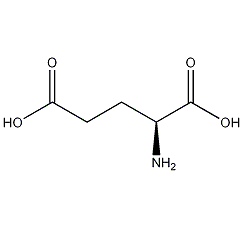
L-glutamic acid

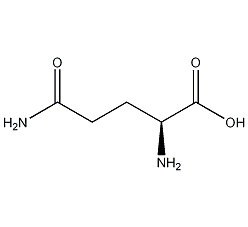
L-glutamic acid structural formula

Structural formula

Business number 0180
Molecular formula C5H9NO4
Molecular weight 147.13
label

(S)-2-Aminoglutaric acid,

glutamine,

(S)-2-Aminoglutaric acid,

L-Glutamic acid,

(S)-(+)-Glutamic acid,

Bitter remover,

intermediates,

Biochemical reagents

Numbering system

CAS number:56-86-0

MDL number:MFCD00002634

EINECS number:200-293-7

RTECS number:LZ9700000

BRN number:1723801

PubChem number:24901609

Physical property data

1. Characteristics: L-glutamic acid is white or colorless scaly crystals, slightly acidic. The racemate, DL-glutamic acid, is a colorless crystal.

2. Density (g/mL, 25/4?): Racemic: 1.4601; Dextral, left-handed: 1.538.

3. Relative vapor density (g/mL, air=1): Undetermined

4. Melting point (ºC): 160

5. Boiling point (ºC, normal pressure): Undetermined

6. Boiling point (ºC, 5.2kPa): Undetermined

7. Refractive index: Undetermined

8 .         Flash point (ºC): Undetermined

9.       Specific rotation (º): [?]D22.4+31.4° (C=1.6mol/L hydrochloric acid)

10. Autoignition point or ignition temperature (ºC): Undetermined

11. Vapor pressure (kPa, 25ºC): Undetermined

12. Saturated vapor pressure (kPa, 60ºC ): Undetermined

13. Heat of combustion (KJ/mol): Undetermined

14. Critical temperature (ºC): Undetermined

15. Critical Pressure (KPa): Undetermined

16. Log value of oil-water (octanol/water) distribution coefficient: Undetermined

17. Explosion upper limit (%, V/V): Undetermined

18. Lower explosion limit (%, V/V): Undetermined

19. Solubility: racemateSlightly soluble in cold water, easily soluble in hot water, almost insoluble in ether, ethanol and acetone. The racemate is slightly soluble in ethanol, ether and petroleum ether.

Toxicological data

1. Acute toxicity: human oral TDLo: 71mg/kg; human intravenous TDLo: 117mg/kg; rat oral LD50: 36mg/kg; rabbit oral LD50: >2300mg/kg 2. Mutagenicity: sister chromatids exchangeTEST system:?Lymphocytes: 10mg/L

Ecological data

General remarks

Water hazard level 1 (German regulations) (self-assessment via list) This substance is slightly hazardous to water.

Do not allow undiluted or large amounts of product to come into contact with groundwater, waterways or sewage systems.

Do not discharge materials into the surrounding environment without government permission.

Molecular structure data

1. Molar refractive index: 31.83

2. Molar volume (cm3/mol): 104.3

3. Isotonic specific volume (90.2K ): 301.0

4. Surface tension (dyne/cm): 69.2

5. Polarizability (10-24cm3): 12.62

Compute chemical data

1. Reference value for hydrophobic parameter calculation (XlogP): None

2. Number of hydrogen bond donors: 3

3. Number of hydrogen bond acceptors: 5

4. Number of rotatable chemical bonds: 4

5. Number of tautomers: none

6. Topological molecule polar surface area 101

7. Number of heavy atoms: 10

8. Surface charge: 0

9. Complexity: 145

10. Number of isotope atoms: 0

11. Determine the number of atomic stereocenters: 1

12. Uncertain number of atomic stereocenters: 0

13. Determine the number of chemical bond stereocenters: 0

14. Number of uncertain chemical bond stereocenters: 0

15. Number of covalent bond units: 1

Properties and stability

1. This product is non-toxic.

2.Odorless, with a slightly special and sour taste.

3. Exist in tobacco leaves and smoke.
?

Storage method

1. This product should be sealed and stored in a cool, dark place.

2. Packed in plastic bags, nylon bags or plastic woven bags, net weight 25kg. During storage and transportation, attention should be paid to moisture-proof, sun-proof and low-temperature storage.

Synthesis method

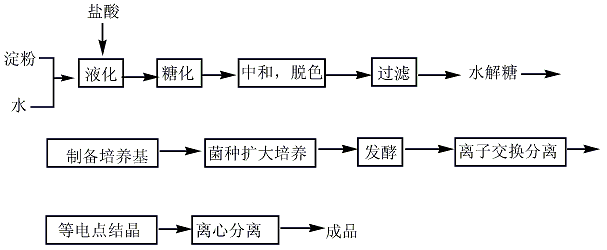
1. Glutamic acid can be produced by protein hydrolysis and synthesis, but fermentation is currently the main method for producing glutamic acid. The carbon source for fermentation to produce glutamic acid is hydrolyzed sugar or molasses from potato, corn, tapioca starch, coconut tree starch and other starches. It can also be acetic acid, liquid paraffin (C16 paraffin is best) and other petrochemical products. The carbon source is Nutrients that constitute the carbon framework and energy in microbial cells and metabolites. Nitrogen sources are ammonium salts, urea, etc. Nitrogen is the main element that constitutes bacterial cell proteins and nucleic acids. Nitrogen is also the main element that constitutes the glutamic acid amino group of fermentation products. Other auxiliary raw materials are inorganic salts, vitamins, etc. For example, microorganisms require appropriate phosphorus concentration, magnesium is an inorganic activator that stimulates bacterial growth, potassium salt promotes acid production, and corn steep liquor provides biotin and organic nitrogen sources. Various accelerators and additives are also included. The producing bacteria are Brevibacterium, Corynebacterium pekinensis, etc. In a large fermentation tank, ferment with aeration and stirring at a temperature of 30-34°C and a pH>7-8. After 30-40 hours of fermentation, remove bacteria and extract glutamic acid from the fermentation liquid. After refining, the finished product is obtained. In the above process Extraction using isoelectric point method, ion exchange method, hydrochloride method, direct concentration method (when acetic acid is used as raw material), etc. can also be used. The product produced by fermentation method is L-glutamic acid, with a content of more than 98%. Each ton of glutamic acid consumes 4000kg of starch (80%) and 25kg of bacteria. The advantage of the synthesis method is that it does not consume food, but the production process requires high pressure (about 20MPa), high temperature (above 120°C), and uses toxic raw materials. The equipment investment is twice as high as that of the fermentation method, and the racemic glutamic acid obtained needs to be further processed. Split, the production process is complex. Calculated based on the production of 1 ton of 99% sodium glutamate (MSG), the synthesis method consumes 640kg of acrylonitrile. When the annual output is more than 5,000t, the production cost is close to that of the acidification method.
2.Fermentation method

3. Chemical synthesis
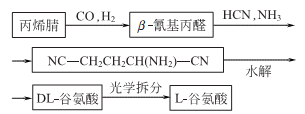
4.This product is mainly made from fermentation Produced by law. Molasses or starch is used as the raw material, Corynebacterium glutamicum or Pediococcus or Arthrobacter is used as the strain, and urea is used as the nitrogen source. Fermentation is carried out at 30 to 32°C. After the fermentation is completed, the bacteria are separated from the fermentation liquid. Use hydrochloric acid to adjust the pH value to 3.0, perform isoelectric point extraction, and obtain glutamic acid crystals after separation. The glutamic acid in the mother liquor is extracted with 732 ion exchange resin, crystallized, and dried to obtain the finished product.

5. Tobacco: BU, 22; FC, 21; L-isomer can be obtained from animal and plant proteins through hydrolysis, decolorization, concentration, and crystallization. It can also be produced from sugar or starch by fermentation. The racemate can be synthesized from acrylonitrile.

Purpose

1.L-Glutamic acid is mainly used in the production of MSG and spices, as well as as salt substitutes, nutritional supplements and biochemical reagents. L-glutamic acid itself can be used as a drug, participating in the metabolism of protein and sugar in the brain and promoting the oxidation process. It combines with ammonia in the body to form non-toxic glutyl glutamic acid.Amine can reduce blood ammonia and relieve symptoms of hepatic coma. It is mainly used to treat hepatic coma and severe liver insufficiency, but the efficacy is not very satisfactory; combined with anti-epileptic drugs, it can still treat petit mal epilepsy and psychomotor seizures. Racemic glutamate is used in the production of drugs and as biochemical reagents.

2.Usually not used alone, but in conjunction with phenolic and quinone antioxidants to obtain good synergistic effects.

3.Glutamic acid is used as a complexing agent for electroless plating.

extended-reading:https://www.bdmaee.net/wp-content/uploads/2022/08/13.jpg
extended-reading:https://www.bdmaee.net/low-odor-catalyst-9727/
extended-reading:https://www.bdmaee.net/nt-cat-la-303-catalyst-cas1066-33-4-newtopchem/
extended-reading:https://www.newtopchem.com/archives/1677
extended-reading:https://www.bdmaee.net/niax-a-1-catalyst-bisdimethylaminoethyl-ether-momentive/
extended-reading:https://www.bdmaee.net/wp-content/uploads/2022/08/-BL-13-Niax-catalyst-A-133-Niax-A-133.pdf
extended-reading:https://www.newtopchem.com/archives/45031
extended-reading:https://www.newtopchem.com/archives/799
extended-reading:https://www.newtopchem.com/archives/category/products/page/66
extended-reading:https://www.cyclohexylamine.net/cas111-41-1/
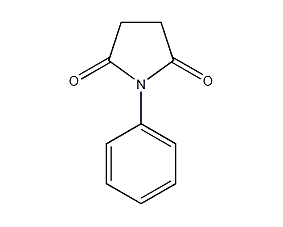
N-phenylsuccinimide

N-phenylsuccinimide structural formula

Structural formula

Business number 01TH
Molecular formula C10H9NO2
Molecular weight 175.18
label

N-Phthalosuccinimide,

1-Phenylsuccinimide

Numbering system

CAS number:83-25-0

MDL number:None

EINECS number:None

RTECS number:None

BRN number:None

PubChem ID:None

Physical property data

1. Physical property data


1. Character: Uncertain


2. Density (g/mL,25/4?): Unsure


3. Relative vapor density (g/mL,AIR=1): Unsure


4. Melting point (ºC):1551


5. Boiling point (ºC,Normal pressure): Uncertain


6. Boiling point (ºC,5.2kPa): Unsure


7. Refractive index: Uncertain


8. Flash Point (ºC): Unsure


9. Specific optical rotation (º): Unsure


10. Autoignition point or ignition temperature (ºC): Unsure


11. Vapor pressure (kPa,25ºC): Unsure


12. Saturated vapor pressure (kPa, 60ºC): Unsure


13. Heat of combustion (KJ/mol): Unsure


14. Critical temperature (ºC): Unsure


15. Critical pressure (KPa): Unsure


16. Oil and water (octanol/Log value of the partition coefficient (water): Uncertain


17. Explosion limit (%,V/V): Unsure


18. Lower explosion limit (%,V/V): Unsure


19. Solubility: Uncertain.

Toxicological data

None

Ecological data

None

Molecular structure data


5. Molecular property data:


1. Molar refractive index: 46.71


2. Molar volume (m3/mol??136.9


3. isotonic ratio (90.2K):371.0


4. Surface Tension (dyne/cm):53.8


5. Polarizability?10-24cm3):18.52


Compute chemical data

1. Reference value for hydrophobic parameter calculation (XlogP): None

2. Number of hydrogen bond donors: 0

3. Number of hydrogen bond acceptors: 2

4. Number of rotatable chemical bonds: 1

5. Number of tautomers: 3

6. Topological molecule polar surface area 37.4

7. Number of heavy atoms: 13

8. Surface charge: 0

9. Complexity: 215

10. Number of isotope atoms: 0

11. Determine the number of atomic stereocenters: 0

12. Uncertain number of atomic stereocenters: 0

13. Determine the number of chemical bond stereocenters: 0

14. Number of uncertain chemical bond stereocenters: 0

15. Number of covalent bond units: 1

Properties and stability

None

Storage method

None

Synthesis method

None

Purpose

None

extended-reading:https://www.morpholine.org/category/morpholine/page/6/
extended-reading:https://www.newtopchem.com/archives/44661
extended-reading:https://www.morpholine.org/potassium-acetate-glycol-solution-polycat-46/
extended-reading:https://www.bdmaee.net/wp-content/uploads/2022/08/31-4.jpg
extended-reading:https://www.cyclohexylamine.net/coordinated-thiol-methyltin-methyl-tin-mercaptide/
extended-reading:https://www.newtopchem.com/archives/40234
extended-reading:https://www.newtopchem.com/archives/44245
extended-reading:https://www.bdmaee.net/catalyst-a-300/
extended-reading:https://www.morpholine.org/category/morpholine/page/5389/
extended-reading:https://www.bdmaee.net/wp-content/uploads/2020/06/70.jpg

L-Glutamine

L-glutamine structural formula

Structural formula

Business number 017Z
Molecular formula C5H10N2O3
Molecular weight 146.15
label

L-Glutamic acid-5-amide,

L-aminocarbonylbutyrine,

L-2-Aminoglutaric acid amide,

(S)-(+)-Glutamine,

L-Glutamic acid 5-amide,

amino acid drugs,

intermediates,

Biochemical reagents

Numbering system

CAS number:56-85-9

MDL number:MFCD00008044

EINECS number:200-292-1

RTECS number:MA2275100

BRN number:1723797

PubChem number:24277983

Physical property data

1. Properties: colorless needle-like crystals

2. Density (g/mL, 25/4?): 1.321

3. Relative vapor density (g/mL , air=1): Undetermined

4. Melting point (ºC, decomposition): 185?186

5. Boiling point (ºC, normal pressure): 185

6. Boiling point (ºC, 5.2kPa): Undetermined

7. Refractive index: Undetermined

8. Flash point (ºC): Undetermined

9. Specific rotation (º): 32.25° (c=10, 2 N HCl).

10. Autoignition point or ignition temperature (ºC): Undetermined

11. Vapor pressure (kPa, 25ºC): Undetermined

12. Saturation Vapor pressure (kPa, 60ºC): Undetermined

13. Heat of combustion (KJ/mol): Undetermined

14. Critical temperature (ºC): Undetermined

15. Critical pressure (KPa): Undetermined

16. Log value of oil-water (octanol/water) partition coefficient: Undetermined

17. Explosion upper limit (% , V/V): Undetermined

18. Lower explosion limit (%, V/V): Undetermined

19. Solubility: soluble in water, almost insoluble in methanol, Ethanol, ether, benzene, acetone, ethyl acetate and chloroform, etc.

Toxicological data

1. Acute toxicity: Men’s oral TDLo: 27mg/kg/1W-I; Rat’s oral LD50: 7500mg/kg; Mice’s oral LD50: 21700mg/kg 2. Other multi-dose toxicity: Rat’s oral TDLo: 260mg/kg/30D-I 3. Mutagenicity: sister chromatids exchangeTEST system: human lymphocytes: 10mg/L

Ecological data

None

Molecular structure data

1. Molar refractive index:33.83

2. Molar volume (cm3/mol): 110.5

3. Isotonic specific volume (90.2K): 313.3

4. Surface tension (dyne/cm): 64.5

5. Polarizability (10-24cm3): 13.41

Compute chemical data

1. Reference value for hydrophobic parameter calculation (XlogP): -3.1

2. Number of hydrogen bond donors: 3

3. Number of hydrogen bond acceptors: 4

4. Number of rotatable chemical bonds: 4

5. Number of tautomers: 2

6. Topological molecular polar surface area (TPSA): 106

7. Number of heavy atoms: 10

8. Surface charge: 0

9. Complexity: 146

10. Isotopes Number of atoms: 0

11. Determine the number of atomic stereocenters: 1

12. Uncertain number of atomic stereocenters: 0

13. Determine chemical bonds Number of stereocenters: 0

14. Number of stereocenters of uncertain chemical bonds: 0

15. Number of covalent bond units: 1

Properties and stability

1. Participate in the biosynthesis of glucosamine, a component of mucin in the digestive tract mucosa, thereby promoting the repair of mucosal epithelial tissue and helping to eliminate ulcer lesions. At the same time, it can promote brain metabolism and improve brain function through the blood-brain barrier. Like glutamate, it is an important nutrient for brain metabolism.

2. Exist in tobacco leaves and smoke.

3. Valuable in the field of immunity. After the body converts toxic ammonia into non-toxic glutamine, it is excreted through urine. Generally not involved in the composition of proteins.

Storage method

This product should be stored in a sealed, cool place and away from light.

Synthesis method

L-Glutamine widely exists in nature. For example, it is contained in free state in pumpkin and sunflower seedlings, and its N-ethyl compound (theanine) is contained in tea leaves. Although glutamine can be extracted from natural products, fermentation and synthesis are used for mass production. 1. Synthesis method: It is obtained by condensation, addition, salt formation and hydrolysis of L-glutamic acid-5-methyl ester ([1499-55-4]). Glutamic acid is esterified with methanol in the presence of concentrated sulfuric acid, and the resulting esterified liquid is added dropwise to the mixture of methanol and carbon disulfide. While adding dropwise, ammonia is circulated under cooling. After the esterification liquid is added dropwise, continue to pass ammonia, then add triethylamine, and leave it sealed at 30°C for 40 hours. After concentrating under reduced pressure to drive out ammonia, a concentrated solution of ?-methyl ester-L-glutamic acid-N-amino acid diammonium salt was obtained. Heat it to 40-45°C and add acetic acid. After stirring for 30 minutes, carbon disulfide was removed under reduced pressure, and a large amount of crystals precipitated. Then add an equal volume of methanol, place it at 0°C for 12 hours, and filter to obtain crude glutamine. The finished product is obtained through activated carbon decolorization and recrystallization. 2. Fermentation method uses glucose, acetic acid, and ethanol as the carbon source of the culture medium, and uses Brevibacterium flavum for fermentation. The yield based on glucose is 39g/L, and the yield is 39%.

2.Synthesis

3.Fermentation method

4. Extracted from the cell wall of fungi.

Purpose

1. This product is converted into sugar amine in the body, which serves as a precursor for mucin synthesis and can promote ulcer healing. It is mainly used as a peptic tract ulcer drug. In addition, it can also be used as a brain function improver and in the treatment of alcoholism.

2.It is used to improve the brain function of children with mental retardation and patients with mental disorders, alcoholism and epilepsy.

3. Nutritional supplements. In medicine, it is used to treat digestive organ ulcers (gastric ulcers, duodenal ulcers) and acute and chronic gastritis. It is also used as a brain function improver and to treat alcoholism.

extended-reading:https://www.newtopchem.com/archives/category/products/page/72
extended-reading:https://www.bdmaee.net/wp-content/uploads/2016/05/Lupragen-N205-MSDS.pdf
extended-reading:https://www.morpholine.org/3-morpholinopropylamine/
extended-reading:https://www.bdmaee.net/nt-cat-ncm-catalyst-cas110-18-9-newtopchem/
extended-reading:https://www.newtopchem.com/archives/44436
extended-reading:https://www.bdmaee.net/hard-foam-catalyst-smp/
extended-reading:https://www.newtopchem.com/archives/1734
extended-reading:https://www.newtopchem.com/archives/39408
extended-reading:https://www.bdmaee.net/wp-content/uploads/2022/08/51.jpg
extended-reading:https://www.bdmaee.net/dabco-tetn-catalyst-cas280-57-9-evonik-germany/