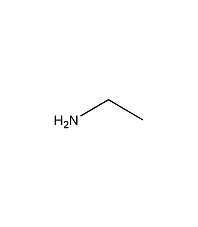
Ethylamine

Ethylamine Structural Formula

Structural formula

Business number 01HV
Molecular formula C2H7N
Molecular weight 45
label

1-aminoethane,

Aminoethane,

Ethanamine,

1-Aminoethane,

Aliphatic carboxylic acids and their derivatives

Numbering system

CAS number:75-04-7

MDL number:MFCD00008160

EINECS number:200-834-7

RTECS number:KH2100000

BRN number:505933

PubChem ID:None

Physical property data

1. Properties: colorless liquid or gas with strong ammonia smell. [1]

2. Melting point (?): -81[2]

3. Boiling point (?): 16.6[3]

4. Relative density (water = 1): 0.70[4]

5. Relative vapor Density (air=1): 1.56[5]

6. Saturated vapor pressure (kPa): 121 (20?)[6]

7. Heat of combustion (kJ/mol): -1713.3[7]

8. Critical temperature (?): 182.9[8]

9. Critical pressure (MPa): 5.62[9]

10. Octanol/water partition coefficient: -0.13[10]

11. Flash point (?): -17 (CC); <-6.7 (OC) [11]

12. Ignition temperature (?): 385[12]

13. Explosion upper limit (%): 14.0[13]

14. Lower explosion limit (%): 3.5[14]

15. Solubility: soluble in water, ethanol, ether, etc. [15]

Toxicological data

1. Acute toxicity[16] LD50: 400mg/kg (rat oral); 390mg/kg (rabbit dermal)

2. Irritation[17]

Rabbit transdermal: 500mg (24h), mild irritation.

Rabbit eye: 250?g (24h), or 5mg, severe irritation.

3. Subacute and chronic toxicity [18] Rabbit inhaled 184mg/m3, 7 hours each time, Five times a week, a large number of lungs, peribronchitis and renal parenchyma degeneration were seen in 6 weeks. Starting from 2 weeks after exposure, rabbit eyes showed epithelial cell erosion and corneal edema.

4. Others[19] LCLo: 3000ppm (rat inhalation, 4h)

Ecological data

1. Ecotoxicity[20]

EC50: 40mg/L (48h) (Daphnia)

IC50: 1.3~2.3mg/L (72h) (algae)

2. Biodegradability[21] MITI-I test, initial concentration 100ppm, sludge concentration 30ppm, 59%~90% degradation after 2 weeks.

3. Non-biodegradability[22] In the air, when the hydroxyl radical concentration is 5.00×10⁵ pcs/cm3, the degradation half-life is 14h (theoretical).

Molecular structure data

1. Molar refractive index: 14.84

2. Molar volume (cm3/mol): 65.2

3. Isotonic specific volume (90.2K ): 140.7

4. Surface tension(dyne/cm): 21.5

5. Polarizability (10-24cm3): 5.88

Compute chemical data

1. Reference value for hydrophobic parameter calculation (XlogP): -0.3

2. Number of hydrogen bond donors: 1

3. Number of hydrogen bond acceptors: 1

p>

4. Number of rotatable chemical bonds: 0

5. Number of tautomers:

6. Topological molecular polar surface area (TPSA): 26

p>

7. Number of heavy atoms: 3

8. Surface charge: 0

9. Complexity: 2.8

10. Number of isotope atoms : 0

11. Determine the number of atomic stereocenters: 0

12. Uncertain number of atomic stereocenters: 0

13. Determine the chemical bond configuration Number of centers: 0

14. Number of uncertain chemical bond stereocenters: 0

15. Number of covalent bond units: 1

Properties and stability

1. Chemical properties: The aqueous solution is alkaline, and its chemical properties are similar to those of methylamine. It is unstable to light and will decompose to produce hydrogen, chlorine, ammonia, methane, ethane, etc. when exposed to ultraviolet light at 140~200°C. Pyrolysis occurs at 490~555? under low pressure to generate hydrogen, chlorine, methane, etc. Ethylamine reacts with sodium hypochlorite to form N-chloroethylamine. Chlorine gas is passed into the ethylamine aqueous solution to generate N,N-dichloroethylamine, which reacts with metal sodium and strontium to generate metal ethylamino compounds.

2. Stability[23] Stable

3. Incompatible substances[24] Strong oxidizing agent, strong acid

4. Polymerization hazard[25] No polymerization

5. Decomposition products[26] Ammonia

Storage method

Storage Precautions[27] Stored in a cool, ventilated warehouse dedicated to flammable gases. Keep away from fire and heat sources. The storage temperature should not exceed 30?. Keep container tightly sealed. They should be stored separately from oxidants and acids, and avoid mixed storage. Use explosion-proof lighting and ventilation facilities. It is prohibited to use mechanical equipment and tools that are prone to sparks. The storage area should be equipped with leakage emergency response equipment.

Synthesis method

1. Ethanol (gas phase) ammoniation method: Add ethanol and ammonia in a ratio of 4:1, at a reaction temperature of 350-400°C, a pressure of 2.45-2.94MPa, and use alumina as a dehydration catalyst. In addition to generating ethylamine, side reactions generate diethylamine, triethylamine, ether, acetonitrile and ethylene. After the crude product obtained by condensing the reaction gas is steamed with ammonia, ethylamine is steamed out with a content of more than 95%. Generally, 50% aqueous solution is used as a commodity. Each ton of 50% aqueous solution consumes about 1,400kg of ethanol (95%).

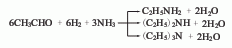
2. Acetaldehyde, hydrogen ammonia The chemical method uses acetaldehyde, hydrogen and ammonia as raw materials and nickel as a catalyst to react to produce ethylamine. First, a structural catalyst with nickel as the main catalyst, reduced copper and reduced chromium as the cocatalyst and kaolin as the carrier is loaded into the reactor, and acetaldehyde is introduced into the reactor at an air velocity of 0.03-0.15L·h-1 to allow hydrogen and acetaldehyde to mix. The ratio is 5:1, and the ratio of ammonia and acetaldehyde is 0.4-3:1. The feedstock is vaporized and entered into the reactor at 80°C. The reaction temperature is controlled between 105-200°C. The product is cooled at -5°C and mono-, di- and triethylamine are separated. Since monoethylamine is formed faster than diethylamine and triethylamine, it is easier to obtain a large amount of ethylamine. When the main product is required to be di- and triethylamine, the generated monoethylamine needs to be recycled into the reaction system for reaction.
Refining method: Ethylamine is often contained Amines such as diethylamine and triethylamine, as well as impurities such as acetaldehyde, a synthetic raw material. It is fractionated and refined under nitrogen flow, then dehydrated with solid potassium hydroxide, decarbonated and dried with sodium fluorenone for later use. If ethylamine hydrochloride is refined, it can be recrystallized with absolute ethanol or a mixture of methanol and chloroform. The melting point is 109~110°C.

Purpose

1. Used in the production of pesticide triazine herbicides, including atrazine and simazine ([122-34-9]). Both herbicides use cyanuric chloride as raw materials and have similar production processes. Atrazine (also known as Trazine) has a wider application range than simazine and can kill simazine-resistant weeds. It was developed and produced by the Swiss company Geigy in 1985 and later developed into the world’s largest-produced herbicide. Ethylamine is also used in the production of dyes, rubber accelerators, surfactants, antioxidants, ion exchange resins, aircraft fuels, solvents, detergents, lubricants, metallurgical dressing agents, as well as cosmetics and pharmaceuticals.

2. Used in dye synthesis and as extraction agents, emulsifiers, pharmaceutical raw materials, reagents, etc. [28]

extended-reading:https://www.cyclohexylamine.net/category/product/page/9/
extended-reading:https://www.bdmaee.net/wp-content/uploads/2022/08/38-7.jpg
extended-reading:https://www.cyclohexylamine.net/category/product/page/10/
extended-reading:https://www.newtopchem.com/archives/45097
extended-reading:https://www.bdmaee.net/wp-content/uploads/2022/08/33-15.jpg
extended-reading:https://www.bdmaee.net/wp-content/uploads/2022/08/-NE1070-polyurethane-gel-type-catalyst–low-odor-catalyst.pdf
extended-reading:https://www.bdmaee.net/dabco-xd-102-catalyst-cas106317-60-3-evonik-germany/
extended-reading:https://www.bdmaee.net/sponge-foaming-catalyst-smp/
extended-reading:https://www.bdmaee.net/wp-content/uploads/2022/08/Dioctyl-dimaleate-di-n-octyl-tin-CAS33568-99-9-Dioctyl-dimaleate-di-n-octyl-tin.pdf
extended-reading:https://www.bdmaee.net/niax-a-337-delayed-tertiary-amine-catalyst-momentive-2/
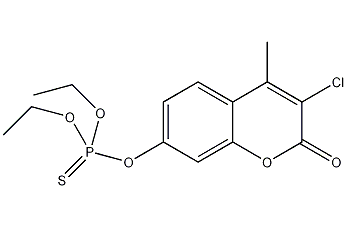
Phosphate

Structural formula of pyridin

Structural formula

Business number 017U
Molecular formula C14H16ClO5PS
Molecular weight 362.77
label

O-(3-chloro-4-methylcoumarin-7-yl)-O,O-diethylphosphorothioate,

coumaphos,

Phosphorus,

Kuma Fushi,

Agridip,

Baymix,

Coumafos,

Meldone,

Coumaphoscumafos,

O-(3-Chloro-4-methylcoumarin-7-yl)-O,O-diethyl phosphorothioate,

Organophosphorus pesticides

Numbering system

CAS number:56-72-4

MDL number:MFCD00041820

EINECS number:200-285-3

RTECS number:GN6300000

BRN number:327083

PubChem number:24868876

Physical property data


1. Characteristics: Colorless crystal. The industry is brown crystal


2. Density (g/mL,25 /4?): 1.474


3. Relative vapor density (g/mL,AIR=1): Undetermined


4. Melting point ( ºC): 95?


5. Boiling point ( ºC,Normal pressure): Undetermined


6.p; Boiling point (ºC,5.2kPa): Undetermined


7. Refractive Index: Undetermined


8. Flashpoint (ºC): Undetermined


9. Specific optical rotation (º): Undetermined


10. Autoignition point or ignition temperature (ºC): Not OK


11. Vapor pressure (kPa,25ºC): Undetermined


12. Saturation vapor pressure (kPa,60ºC): Undetermined


13. heat of combustion (KJ/mol): Undetermined


14. Critical temperature (ºC): Undetermined


15. Critical Pressure (KPa): Undetermined


16. Oil and water (octanol/Log value of partition coefficient for water: undetermined


17. Explosion limit (%,V/V): Not OK


18. Lower explosion limit (%,V/V): Not OK


19. Solubility:Slightly soluble in water


Toxicological data

None

Ecological data

None

Molecular structure data


1. Molar refractive index: 86.84


2. Molar volume (m3/mol??261.8


3. isotonic specific volume (90.2K):709.5


4. Surface Tension (dyne/cm):53.9


5. Polarizability?10-24cm3): 34.42


Compute chemical data

1. Reference value for hydrophobic parameter calculation (XlogP): 4.5

2. Number of hydrogen bond donors: 0

3. Number of hydrogen bond acceptors: 6

4. Number of rotatable chemical bonds: 6

5. Number of tautomers: none

6. Topological molecule polar surface area 86.1

7. Number of heavy atoms: 22

8. Surface charge: 0

9. Complexity: 500

10. Number of isotope atoms: 0

11. Determine the number of atomic stereocenters: 0

12. Uncertain number of atomic stereocenters: 0

13. Determine the number of chemical bond stereocenters: 0

14. Number of uncertain chemical bond stereocenters: 0

15. Number of covalent bond units: 1

Properties and stability

None

Storage method

This product should be kept sealed.

Synthesis method

(1)200gethyl acetoacetate and270g SO2CI2, respectively dissolved in100mlbenzene, then in10?, SO2CI2It is obtained by dropping a benzene solution into a benzene solution of ethyl acetoacetate. (2) resorcin88gand?-Ethyl acetoacetate chloride132gDrip640mlIn concentrated sulfuric acid, the temperature is 5Obtained by reaction below ?3-chlorine-4-Methyl-7-Hydroxycoumarin. 44g 3-Chlorine-4- Methyl-7-Hydroxycoumarin,29gAnhydrous potassium carbonate is placed together500mlIn methyl ethyl ketone, add dropwise under reflux and stirring40g O,O-Diethylphosphorothioate chloride, reflux2h And get fly poison phosphorus.

Purpose

fly poison Phosphorus-based non-systemic insecticides are particularly effective against dipteran pests. They are also used to control external parasites and are effective in controlling skin flies.

extended-reading:https://www.morpholine.org/polyester-sponge-special-catalyst-sponge-catalyst-dabco-ncm/
extended-reading:https://www.newtopchem.com/archives/43987
extended-reading:https://www.bdmaee.net/n-butyltin-hydroxide-oxide/
extended-reading:https://www.bdmaee.net/fascat4201-catalyst-cas-818-08-6-dibutyl-tin-oxide/
extended-reading:https://www.newtopchem.com/archives/category/products/page/13
extended-reading:https://www.bdmaee.net/low-odor-reaction-type-catalyst/
extended-reading:https://www.cyclohexylamine.net/reaction-type-catalyst-9727-polyurethane-amine-catalyst-9727/
extended-reading:https://www.bdmaee.net/tertiary-amine-composite-catalyst/
extended-reading:https://www.newtopchem.com/archives/39941
extended-reading:https://www.newtopchem.com/archives/39958

Ethyl iodide

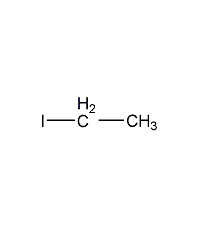
Structural formula of ethyl iodide

Structural formula

Business number 01HU
Molecular formula C2H5I
Molecular weight 155.97
label

ethyl iodide,

Ethyl iodide,

Ethyl iodide,

Hydrodic ether,

1-Iodoethane,

Monoiodoethane,

Ethyl iodide,

Aliphatic halogenated derivatives

Numbering system

CAS number:75-03-6

MDL number:MFCD00001091

EINECS number:200-833-1

RTECS number:KI4750000

BRN number:505934

PubChem number:24845689

Physical property data

1. Characteristics: Colorless, clear and heavy liquid with an ether smell. [1]

2. Melting point (?): -108[2]

3. Boiling point (?): 69~73[3]

4. Relative density (water=1): 1.95[4]

5. Relative vapor density (air = 1): 5.38[5]

6. Saturated vapor pressure (kPa): 13.33 (18.0?)[6]

7. Heat of combustion (kJ/mol): -1490.6[7]

8. Critical pressure (MPa): 5.99[ 8]

9. Octanol/water partition coefficient: 2.0[9]

10. Flash point (?): >71 [10]

11. Solubility: Insoluble in water, soluble in most organic solvents such as ethanol, ether, and hydrocarbons. [11]

12. Relative density (20?, 4?): 1.9357

13. Refractive index at room temperature (n20

sup>): 1.5133

14. Refractive index at room temperature (n25): 1.5101

15. Liquid phase standard claims heat (enthalpy) (kJ· mol-1): -39.5

16. Solubility parameter (J·cm-3)0.5: 19.078

17. van der Waals area (cm2·mol-1): 5.950×10⁹

18. van der Waals volume (cm3·mol-1): 43.080

19. Gas phase standard claims heat (enthalpy) (kJ·mol-1): -7.5

20. Gas phase standard entropy (J·mol-1·K-1): 295.63

21. Gas phase standard formation free energy (kJ·mol-1): 20.7

22. Gas phase standard hot melt ( J·mol-1·K-1)?65.33

Toxicological data

1. Acute toxicity[12]

LD50: 330mg/kg (oral in rats); 560mg/kg (oral in mice) Oral)

LC50: 65000mg/m3 (rat inhalation, 1/2h)

2. Irritation Temporary No information

3. Mutagenicity [13] Mutagenicity of Escherichia coli: 20 ?mol/L; DNA damage: 1 ?mol/L.

Ecological data

1. Ecotoxicity No data available

2. Biodegradability No data available

3 .Non-biodegradability No information available

4. Other harmful effects[14] This substance hasThe environment is hazardous and attention should be paid to atmospheric pollution.

Molecular structure data

1. Molar refractive index: 24.28

2. Molar volume (cm3/mol): 80.3

3. Isotonic specific volume (90.2K ): 185.7

4. Surface tension (dyne/cm): 28.5

5. Polarizability (10-24cm3): 9.62

Compute chemical data

1. Reference value for hydrophobic parameter calculation (XlogP): 2.1

2. Number of hydrogen bond donors: 0

3. Number of hydrogen bond acceptors: 0

4. Number of rotatable chemical bonds: 0

5. Number of tautomers:

6. Topological molecular polar surface area (TPSA): 0

7. Number of heavy atoms: 3

8. Surface charge: 0

9. Complexity: 2.8

10. Number of isotope atoms: 0

11. Determine the number of atomic stereocenters: 0

12. Uncertain number of atomic stereocenters: 0

13. Determine the number of chemical bond stereocenters Number: 0

14. Number of uncertain chemical bond stereocenters: 0

15. Number of covalent bond units: 1

Properties and stability

1. Stability[15] Stable

2. Incompatible substances[16] Strong oxidizing agent, strong alkali

3. Conditions to avoid contact [17] Heat, light, contact with air

4. Polymerization hazard[18] No polymerization

5. Decomposition products[19] Hydrogen iodide

Storage method

1. Packed in 25~500ml glass bottles and protected by wooden boxes or cartons. Store in a cool, dry and ventilated warehouse, away from fire, heat sources and protected from light. Do not mix with edible chemical raw materials.

2. Storage precautions [20] Store in a cool, ventilated warehouse. Keep away from fire and heat sources. Avoid light. The packaging must be sealed and must not come into contact with air. They should be stored separately from oxidants, alkalis, and food chemicals, and avoid mixed storage. Equipped with the appropriate variety and quantity of fire equipment. The storage area should be equipped with emergency release equipment and suitable containment materials.

Synthesis method

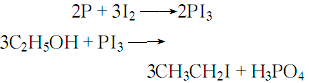
1. Obtained from the reaction of ethanol and phosphorus triiodide. Put industrial ethanol and red phosphorus into the reaction bottle, heat to reflux on a water bath, and slowly add iodine granules. After the addition is completed, continue refluxing for 3 hours. The reaction solution is then distilled to evaporate the yellow crude product, which is washed and dried to obtain the finished product. In addition, ethyl iodide can also be produced by the addition of ethylene and hydrogen iodide. The reaction formula is:

2. It is produced by the addition reaction of ethylene and hydriodic acid.

3. From ethanol and triiodine Derived from the reaction of phosphorus. The operation process is as follows: place ethanol and red phosphorus in a reaction bottle, heat and reflux on a water bath, slowly add iodine particles, and continue to reflux. Then the reaction liquid is evaporated to obtain a yellow crude product, which is then washed, dried and filtered to obtain the finished product.

Purpose

1. Used as chemical reagents and pharmaceutical penetration aids (to measure cardiac blood output). Also used in organic synthesis and as reagents. Goiter treatment drugs, plant growth stimulating hormone, etc.

2. Determine the refractive index of minerals. Calibrate the refractometer. Separate minerals. Measurement of cardiac blood output.

3. Used as analytical reagents, such as for measuring refractive index.

4. Used in medicine and organic synthesis. [21]

extended-reading:https://www.newtopchem.com/archives/category/products/page/4
extended-reading:https://www.newtopchem.com/archives/category/products/page/6
extended-reading:https://www.cyclohexylamine.net/category/product/page/21/
extended-reading:https://www.morpholine.org/elastomer-environmental-protection-catalyst-nt-cat-e-129/
extended-reading:https://www.cyclohexylamine.net/potassium-acetate-glycol-solution-polycat-46/
extended-reading:https://www.bdmaee.net/wp-content/uploads/2022/08/-NE500-non-emission-amine-catalyst-NE500-strong-gel-amine-catalyst-NE500.pdf
extended-reading:https://www.newtopchem.com/archives/category/products/page/99
extended-reading:https://www.bdmaee.net/dabco-tl-low-odor-tertiary-amine-catalyst-dabco-low-odor-tertiary-amine-catalyst/
extended-reading:https://www.bdmaee.net/catalyst-a300-a300-nt-cat-300/
extended-reading:https://www.bdmaee.net/dimethylbis1-oxoneodecyloxystannane/