4-amino-3-nitrobenzene

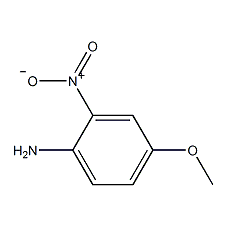
4-Amino-3-nitrobenzene structural formula

Structural formula

Business number 02BN
Molecular formula C7H8N2O3
Molecular weight 168.15
label

2-nitro-4-methoxyaniline,

2-Nitro-4-methoxyaniline,

4-Methoxy-2-nitroaniline,

Aromatic nitrogen-containing compounds and their derivatives

Numbering system

CAS number:96-96-8

MDL number:MFCD00007152

EINECS number:202-547-2

RTECS number:BY4415000

BRN number:880318

PubChem number:24896683

Physical property data

1. Properties: Orange-red powder, which can evaporate with water vapor.

2. Density (g/mL, 20?): Undetermined

3. Relative vapor density (g/mL, air=1): Undetermined

4. Melting point (ºC): 129

5. Boiling point (ºC, normal pressure): Undetermined

6. Boiling point (ºC, kPa): Undetermined

7. Refractive index: Undetermined

8. Flash point (ºC): Undetermined

9. Specific rotation (º): Undetermined

10. Autoignition point or ignition temperature (ºC): Not determined

11. Vapor pressure (mmHg, 20.2ºC): Not determined

12. Saturated vapor pressure ( kPa, ºC): Undetermined

13. Heat of combustion (KJ/mol): Undetermined

14. Critical temperature (ºC): Undetermined

15. Critical pressure (KPa): Undetermined

16. Log value of oil-water (octanol/water) distribution coefficient: Undetermined

17. Explosion upper limit (%, V/ V): Undetermined

18. Lower explosion limit (%, V/V): Undetermined

19. Solubility: Slightly soluble in cold water, soluble in hot water, ethanol, Ether and dioxane, slightly soluble in benzene.

Toxicological data

Acute toxicity: rat oral LD50: 14100mg/kg

Ecological data

It is extremely harmful to water and toxic to fish. Do not let the product enter the water body.

Molecular structure data

1. Molar refractive index: 43.71

2. Molar volume (cm3/mol): 127.5

3. Isotonic specific volume (90.2K ): 345.2

4. Surface tension (dyne/cm): 53.6

5. Polarizability (10-24cm3): 17.32

Compute chemical data

1. Reference value for hydrophobic parameter calculation (XlogP): None

2. Number of hydrogen bond donors: 1

3. Number of hydrogen bond acceptors: 4

4. Number of rotatable chemical bonds: 1

5. Number of tautomers: none

6. Topological molecule polar surface area 81.1

7. Number of heavy atoms: 12

8. Surface charge: 0

9. Complexity: 169

10. Number of isotope atoms: 0

11. Determine the number of atomic stereocenters: 0

12. Uncertain number of atomic stereocenters: 0

13. Determine the number of chemical bond stereocenters: 0

14. Number of uncertain chemical bond stereocenters: 0

15. Number of covalent bond units: 1

Properties and stability

Avoid contact with oxides.

This product is toxic. For its toxicity and protective methods, please refer to o-nitroaniline (C269).
?

Storage method

1. Store in a cool, ventilated warehouse. Keep away from fire and heat sources. Keep container tightly sealed. should be kept away from oxidizer, do not store together. Equipped with the appropriate variety and quantity of fire equipment. Suitable materials should be available in the storage area to contain spills.

2. Packed in iron drums lined with plastic bags. 50kg per barrel. Should be stored in a dry, ventilated place. Avoid sunlight, moisture and heat. Store and transport according to regulations on toxic chemicals.

Synthesis method

1. Method 1: Obtained from nitration and hydrolysis of p-methoxyacetanilide. Add p-methoxyacetanilide and sodium bisulfite to chlorobenzene, slowly add 61% nitric acid at 28°C, first quickly and then slowly within 4 hours. The reaction temperature is controlled at 25-30°C. The addition process Add sodium bisulfite every hour. After the addition is completed, react at 25-30°C for 1.5 hours. Add water, let it sit and then separate the upper acid layer. Add this nitration product to water, add sodium sulfite and adjust the pH value to 7-7.5, and remove chlorobenzene by distillation. Cool to 40°C and add 30% sodium hydroxide solution. Then raise the temperature to 76-77°C within 1 hour and keep it at 77°C for 2 hours. Cool to 30°C, press filter, wash the filter cake with 30°C water until neutral, and dry it. The yield is 80%. Raw material consumption quota: p-methoxyacetanilide (99%) 1629kg/t, chlorobenzene 300kg/t, nitric acid (96%) 590kg/t, liquid alkali (30%) 1300kg/t. Method 2: Use p-aminoanisole as raw material, acidify it with glacial acetic acid, nitrate it with nitric acid and chlorobenzene, then hydrolyze it in the presence of sodium hydroxide, and then filter and dry it. Product specification requirements: content (diazo value) ?97%, content of impurities insoluble in hydrochloric acid ?1%, melting point of dry product 121°C. Raw material consumption quota: para-aminoanisole (100%) 1000kg/t, chlorobenzene 450kg/t, glacial acetic acid (98%) 600kg/t, sodium hydroxide (100%) 330kg/t, nitric acid (98%) 660kg /t, sodium metabisulfite 16kg/t.
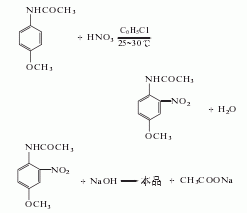
2. Use acetaminophen Methyl ether is used as raw material and is obtained through nitrification, hydrolysis and refining. .
In the nitrification pot, add 750kg of chlorobenzene, 150kg of salt, and 34.4kg of nitric acid (actually 41L, mass 56kg, 63%), then add 300kg of acetaminophen and 103.2kg of nitric acid within 3 hours. (Actually added 132L, mass 168kg, 63%). The reaction temperature was controlled at 20-30°C. After the addition is complete, continue stirring at 30°C for 1 hour. Then add about 31kg sodium carbonate to neutralize to slightly alkaline. Pump the nitrate into the distillation kettle, steam out the chlorobenzene with direct steam, and then reuse it. After distilling off the chlorobenzene, the mixture is left to be hydrolyzed.
Cool the mixture after steaming out the chlorobenzene to 70?, add 100kg sodium hydroxide (to make a 50% solution), then add water until the volume reaches 1950L, and the temperature drops to 40-50?. Slowly heat the mixture to 75°C and maintain it at 75-77°C for 2 hours. The feed liquid must remain alkaline. When the melting point of the product reaches 123-124°C, the hydrolysis reaction can be stopped. Cool to 30°C, filter, and wash with water until no alkali is contained. After vacuum drying at 95°C, the crude product was obtained by crushing. The crude product can be recrystallized with hot water to obtain fine product with a melting point of 125-126°C.

Purpose

Used as an intermediate for photosensitive materials. It can also be used as an intermediate for dyes, medicines, and photosensitive materials. It is also used as a raw material for the antimalarial drug primaquinoline in medicine. It is mainly used as the color base of ice dyeing dyes, that is, maroon base GP, used for dyeing cotton, linen, and viscose fabrics and as a color developer for printing. Also used as an intermediate for photosensitive materials. In the pharmaceutical industry, it is used as a raw material for the production of antimalarial drug primaquinoline.

extended-reading:https://www.newtopchem.com/archives/44386
extended-reading:https://www.bdmaee.net/wp-content/uploads/2022/08/FASCAT4224-catalyst-CAS-68298-38-4-dibutyl-tin-bis-1-thioglycerol.pdf
extended-reading:https://www.bdmaee.net/catalyst-pt303/
extended-reading:https://www.bdmaee.net/cas-23850-94-4-2/
extended-reading:https://www.newtopchem.com/archives/category/products/page/62
extended-reading:https://www.newtopchem.com/archives/1824
extended-reading:https://www.bdmaee.net/wp-content/uploads/2022/08/Tetramethylpropanediamine-CAS110-95-2-TMPDA.pdf
extended-reading:https://www.newtopchem.com/archives/39987
extended-reading:https://www.bdmaee.net/wp-content/uploads/2022/08/59.jpg
extended-reading:https://www.cyclohexylamine.net/dabco-ne500-non-emission-amine-catalyst-ne500/
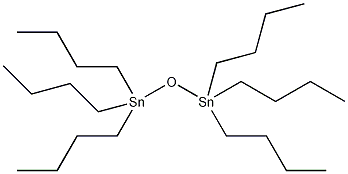
Bis(tributyltin)oxide

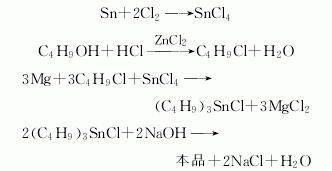
Bis(tributyltin) oxide structural formula

Structural formula

Business number 017G
Molecular formula C24H54OSn2
Molecular weight 598
label

Bistributyltin oxide,

fungicides,

Elemental organic compounds

Numbering system

CAS number:56-35-9

MDL number:MFCD00009418

EINECS number:200-268-0

RTECS number:JN8750000

BRN number:745057

PubChem number:24891834

Physical property data

1. Properties: slightly yellow liquid.

2. Density (g/mL, 25/4?): 1.17

3. Relative vapor density (g/mL, air=1): Undetermined

4. Melting point (ºC): -45

5. Boiling point (ºC, normal pressure): Undetermined

6. Boiling point (ºC, 266.6Pa): 180

7. Refractive index: Undetermined

8. Flash point (ºC): >100

9. Specific rotation (º): Undetermined

7. p>

10. Autoignition point or ignition temperature (ºC): Undetermined

11. Vapor pressure (kPa, 25ºC): Undetermined

12. Saturated vapor pressure (kPa, 60ºC): Undetermined

13. Heat of combustion (KJ/mol): Undetermined

14. Critical temperature (ºC): Undetermined

15. Critical pressure (KPa): Undetermined

16. Log value of oil-water (octanol/water) partition coefficient: Undetermined

17. Explosion upper limit (%, V /V): Undetermined

18. Lower explosion limit (%, V/V): Undetermined

19. Solubility: Miscible with organic solvents, almost insoluble in water .

Toxicological data

This product is toxic and may cause poisoning if swallowed or absorbed through the skin. Acute poisoning can have an incubation period of 3 to 5 days. During this period, sometimes only a mild headache is felt, and sometimes there is no discomfort at all. In the early stage of poisoning, there are symptoms such as headache, bloating, dizziness, general weakness, loss of appetite, etc., sometimes accompanied by symptoms such as nausea, vomiting, insomnia, weight loss, etc. In severe cases, the condition worsens and mental disorder, coma, decreased blood pressure, and increased cerebral pressure occur. , urinary retention, paralysis and other symptoms, and even death. The maximum allowable concentration in the air is 0.1mg/m3.

Ecological data

None

Molecular structure data

None

Compute chemical data

1. Reference value for hydrophobic parameter calculation (XlogP): None

2. Hydrogen??Number of donors: 0

3. Number of hydrogen bond acceptors: 1

4. Number of rotatable chemical bonds: 20

5. Mututation Number of conformers: None

6. Topological molecule polar surface area 9.2

7. Number of heavy atoms: 27

8. Surface charge: 0

9. Complexity: 246

10. Number of isotope atoms: 0

11. Determine the number of atomic stereocenters: 0

12. The number of uncertain stereocenters of atoms: 0

13. The number of determined stereocenters of chemical bonds: 0

14. The number of uncertain stereocenters of chemical bonds: 0

15. Number of covalent bond units: 1

Properties and stability

1. This product is toxic and may cause poisoning if swallowed or absorbed through the skin. Acute poisoning can have an incubation period of 3 to 5 days. During this period, sometimes only a mild headache is felt, and sometimes there is no discomfort at all. In the early stage of poisoning, there are symptoms such as headache, bloating, dizziness, general weakness, loss of appetite, etc., sometimes accompanied by symptoms such as nausea, vomiting, insomnia, weight loss, etc. In severe cases, the condition worsens and mental disorder, coma, decreased blood pressure, and increased cerebral pressure occur. , urinary retention, paralysis and other symptoms, and even death. The maximum allowable concentration in the air is 0.1mg/m3. Production equipment should be sealed, the room should be well ventilated, and operators should wear protective equipment.
?

Storage method

This product should be kept sealed. Packed in tinplate barrels, 15kg per barrel. Store and transport according to regulations on toxic drugs.

Synthesis method

1. The reaction between anhydrous tin tetrachloride and butylmagnesium bromide produces tetrabutyltin, which then reacts with tin tetrachloride to form tributyltin. Butyltin chloride finally reacts with potassium hydroxide to obtain tributyltin oxide.

Purpose

1. Oxidizing agent. Decompose monoesters (including those containing peptide bonds). Fungicides. Fungicides. Pesticides. Antifouling paint.

2.Organotin molecules can penetrate the cell membrane and compete with cations associated with acidic groups in proteins and enzymes, causing extreme cell metabolism. Disturbance leads to the death of microorganisms. Organotin can be used to inhibit slime-producing bacteria, and is also effective in killing sulfate-reducing bacteria and certain gas-producing bacteria.

3. Used to prepare anti-corrosion paint and pesticides, such as fumigants and disinfectants.

extended-reading:https://www.newtopchem.com/archives/1738
extended-reading:https://www.newtopchem.com/archives/39611
extended-reading:https://www.newtopchem.com/archives/1006
extended-reading:https://www.newtopchem.com/archives/1118
extended-reading:https://www.bdmaee.net/2114-2/
extended-reading:https://www.bdmaee.net/wp-content/uploads/2022/08/N-cyclohexyl-N-methylcyclohexylamine-CAS-7560-83-0-N-methyldicyclohexylamine.pdf
extended-reading:https://www.bdmaee.net/cas-2212-32-0/
extended-reading:https://www.cyclohexylamine.net/pentamethyldipropene-triamine-cas-3855-32-1/
extended-reading:https://www.newtopchem.com/archives/672
extended-reading:https://www.newtopchem.com/archives/1061

Guaiacol glyceryl ether

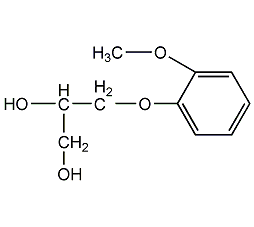
Guaiacol glyceryl ether structural formula

Structural formula

Business number 025V
Molecular formula C10H14O4
Molecular weight 198.22
label

Guaifenesin,

3-(o-methoxyphenoxy)-1,2-propanediol,

Glyceryl Guaiac,

Glyceryl guaiacol,

Guaifenesin,

3-(2-Methoxyphenosy)-1,2-propamediol,

Aeronesin

Numbering system

CAS number:93-14-1

MDL number:MFCD00016873

EINECS number:202-222-5

RTECS number:TY8400000

BRN number:2049375

PubChem number:24895219

Physical property data

1. Properties: colorless flaky crystals.

2. Density (g/mL, 25/4?): Undetermined

3. Relative vapor density (g/mL, air=1): Undetermined

4. Melting point (ºC): 76?78

5. Boiling point (ºC, normal pressure): Undetermined

6. Boiling point (ºC, 80kPa): 147.7

7. Refractive index: Undetermined

8. Flash point (ºC): Undetermined

9. Specific rotation (º): Undetermined

10. Autoignition point or ignition temperature (ºC): Undetermined

11. Vapor pressure (kPa, 25ºC): Undetermined

12. Saturated vapor Pressure (kPa, 60ºC): Undetermined

13. Heat of combustion (KJ/mol): Undetermined

14. Critical temperature (ºC): Undetermined

15. Critical pressure (KPa): Undetermined

16. Log value of oil-water (octanol/water) partition coefficient: Undetermined

17. Explosion upper limit (%, V/V): Undetermined

18. Lower explosion limit (%, V/V): Undetermined

19. Solubility: Soluble in ethanol, ether and benzene, slightly soluble In petroleum ether, insoluble in water.

Toxicological data

None

Ecological data

None

Molecular structure data

1. Molar refractive index: 51.90

2. Molar volume (cm3/mol): 165.8

3. Isotonic specific volume (90.2K ): 431.0

4. Surface tension (dyne/cm): 45.6

5. Polarizability (10-24cm3): 20.57

Compute chemical data

1. Reference value for hydrophobic parameter calculation (XlogP): None

2. Number of hydrogen bond donors: 2

3. Number of hydrogen bond acceptors: 4

4. Number of rotatable chemical bonds: 5

5. Number of tautomers: none

6.?The polar surface area of ??the molecule is 58.9

7. Number of heavy atoms: 14

8. Surface charge: 0

9. Complexity: 151

p>

10. Number of isotope atoms: 0

11. Number of determined atomic stereocenters: 0

12. Number of uncertain atomic stereocenters: 1

13. Determine the number of stereocenters of chemical bonds: 0

14. Uncertain number of stereocenters of chemical bonds: 0

15. Number of covalent bond units: 1

Properties and stability

None

Storage method

This product should be kept sealed and dry.

Synthesis method

Originated from the condensation of sodium guaiacol and 3-chloropropanediol. Prepare sodium hydroxide solution and guaiacol at 40°C to form sodium phenate, add 3-chloro-1,2-propanediol, naturally raise the temperature to 95°C, react at 92-98°C for 3 hours, let it stand, and remove the salt water layer. , add hydrochloric acid to acidify to pH 3-5, cool and crystallize, and filter. The filter cake is recrystallized with ethanol to obtain guaifenesin. The yield is about 60%.

Purpose

This product is an expectorant and antitussive medicine.

extended-reading:https://www.newtopchem.com/archives/640
extended-reading:https://www.newtopchem.com/archives/915
extended-reading:https://www.bdmaee.net/wp-content/uploads/2022/08/Jeffcat-DMP-Lupragen-N204-PC-CAT-DMP.pdf
extended-reading:https://www.bdmaee.net/wp-content/uploads/2022/08/Dimethyltin-Dichloride-CAS-753-73-1-dimethyl-tin-dichloride.pdf
extended-reading:https://www.cyclohexylamine.net/acetic-acid-potassium-salt-potassium-acetate/
extended-reading:https://www.cyclohexylamine.net/dabco-bl-13-niax-a-133-jeffcat-zf-24/
extended-reading:https://www.morpholine.org/cas-63469-23-8/
extended-reading:https://www.bdmaee.net/di-n-octyltin-dilaurate-cas3648-18-8-dotdl/
extended-reading:https://www.newtopchem.com/archives/44909
extended-reading:https://www.cyclohexylamine.net/semi-hard-foam-catalyst-tmr-3-hard-foam-catalyst-tmr-3/