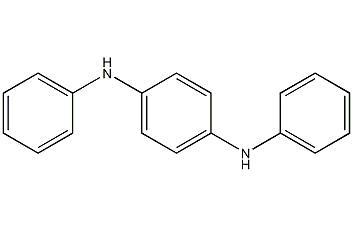
N,N’-diphenyl-p-phenylenediamine

N,N'-diphenyl-p-phenylenediamine structural formula

Structural formula

Business number 01HG
Molecular formula C18H16N2
Molecular weight 260.33
label

Anti-aging agent PPD,

diphenyltetraphenyldiamine,

1,4-Diphenylaminobenzene,

Antioxidant PPD,

2-phenyl-4-phenyl-diamine,

1,4 – diphenyl benzene,

Universal antioxidant

Numbering system

CAS number:74-31-7

MDL number:MFCD00003015

EINECS number:200-806-4

RTECS number:ST2275000

BRN number:2215944

PubChem number:24867020

Physical property data

1. Properties: gray powder or flakes. Is flammable. The color becomes darker in the air and under light

2. Density (g/mL, 25/4?): 1.22?1.31

3. Relative vapor density (g/mL, air=1): Uncertain

4. Melting point (ºC): 152

5. Boiling point ( ºC, normal pressure): 282

6. Boiling point (ºC, 0.5mmHg): 220-225

7. Refractive index: Uncertain

8. Flash point (ºC, 1mmHg): 220-225

9. Specific rotation (º): Uncertain

10. Autoignition point or ignition temperature (ºC): Uncertain

11. Vapor pressure (kPa, 25 ºC): Uncertain

12. Saturated vapor pressure (kPa, 60 ºC): Uncertain

13. Heat of combustion (KJ/mol): Uncertain

14. Critical temperature (ºC): Uncertain

15. Critical pressure (KPa): Uncertain

16. The logarithmic value of the oil-water (octanol/water) partition coefficient: Uncertain

17. The upper explosion limit (%, V/V): Uncertain

18. The lower explosion limit (%, V/V): Uncertain

19. Solubility: Soluble in benzene and ethanol, insoluble in gasoline and water (<0.1 g/100 mL at 20 ºC)

Toxicological data

Acute toxicity: rat oral LD50: 2370 mg/kg; mouse oral LD50: 18 mg/kg; mouse intraperitoneal LD50: 300 mg/kg; tumorigenicity: mouse subcutaneous injection TDLo: 1000 mg/kg; breeding : Rat oral TDLo: 450 mg/kgSEX/DURATION: female 14 day(s) pre-mating female 1-22 day(s) after conception; Rat oral TDLo: 2500 mg/kgSEX/DURATION: female 1- 22 day(s) after conception; Mouse oral TDLo: 4176 mg/kgSEX/DURATION: female 6-14 day(s) after conception; Mutagenicity: SandMicrobial test system for Mammalian gene mutation: 10 ug/plate; Hamster lung cytogenetic analysis test system: 1800 ug/L; Hamster lung Mutation in mammalian somatic cellsTEST SYSTEM: 30 mg/L;

Ecological data

None

Molecular structure data

5. Molecular property data:

1. Molar refractive index: 85.00

2. Molar volume (cm3/mol): 221.5

3. Isotonic specific volume (90.2K): 593.9

4. Surface tension (dyne/cm): 51.6

5. Polarizability (10-24cm3): 33.69

Compute chemical data

1. Reference value for hydrophobic parameter calculation (XlogP): None

2. Number of hydrogen bond donors: 2

3. Number of hydrogen bond acceptors: 2

4. Number of rotatable chemical bonds: 4

5. Number of tautomers: none

6. Topological molecule polar surface area 24.1

7. Number of heavy atoms: 20

8. Surface charge: 0

9. Complexity: 231

10. Number of isotope atoms: 0

11. Determine the number of atomic stereocenters: 0

12. Uncertain number of atomic stereocenters: 0

13. Determine the number of chemical bond stereocenters: 0

14. Number of uncertain chemical bond stereocenters: 0

15. Number of covalent bond units: 1

Properties and stability

None

Storage method

Stored in a cool, dry warehouse, protected from fire, moisture and sun.

Synthesis method

Hydroquinone and aniline react under the catalysis of triethyl phosphate for a certain period of time at 280~300? and a pressure of 0.7MPa. After the reaction, vacuum distillation was performed. Excess aniline is removed first under low vacuum, and then the intermediate is evaporated under higher vacuum. The remaining materials after steaming the intermediate are sliced, powdered, and packaged to become the finished product. The synthesis reaction is as follows

Purpose

is a general-purpose antioxidant. It has excellent resistance to flexural cracking and has excellent protection against heat, oxygen, ozone, and photoaging, especially copper and manganese damage. It is polluting and will discolor the rubber. It is not suitable for light-colored and bright-colored products. It is often used in the manufacture of various tires and dark-colored products. Because of its low solubility in rubber, it is easy to bloom. Mainly used as rubber antioxidant, suitable for natural rubber, styrene-butadiene rubber, and butadiene rubber. The reference dosage is 0.2 to 0.3 parts by mass.

extended-reading:https://www.bdmaee.net/niax-ef-600-low-odor-balanced-tertiary-amine-catalyst-momentive/
extended-reading:https://www.newtopchem.com/archives/category/products/page/123
extended-reading:https://www.cyclohexylamine.net/amine-catalyst-dabco-8154-catalyst-dabco-8154/
extended-reading:https://www.morpholine.org/acetic-acid-potassium-salt/
extended-reading:https://www.bdmaee.net/potassium-acetate-2/
extended-reading:https://www.newtopchem.com/archives/44594
extended-reading:https://www.morpholine.org/cas-7560-83-0/
extended-reading:https://www.cyclohexylamine.net/strong-gel-catalyst-dabco-dc1-delayed-strong-gel-catalyst/
extended-reading:https://www.bdmaee.net/dioctyltin-dilaurate-dotdl/
extended-reading:https://www.newtopchem.com/archives/1063
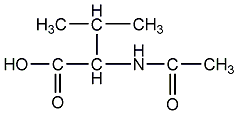
N-acetyl-L-valine

N-acetyl-L-valine structural formula

Structural formula

Business number 02BH
Molecular formula C7H13NO3
Molecular weight 159.18
label

L-2acetamido-3-methylbutyric acid,

N-acetyl-L-andrographis amino acid,

L-2-Acetamido-3-methylbutyric acid

Numbering system

CAS number:96-81-1

MDL number:MFCD00066066

EINECS number:202-537-8

RTECS number:None

BRN number:None

PubChem ID:None

Physical property data

1. Character: white crystal

2. Density (g/mL, 20?): Undetermined

3. Relative vapor density (g/mL, air=1 ): Undetermined

4. Melting point (ºC): Undetermined

5. Boiling point (ºC, normal pressure): Undetermined

6. Boiling point ( ºC, KPa): Not determined

7. Refractive index: Not determined

8. Flash point (ºC): Not determined

9. Specific rotation (º): -16–20

10. Autoignition point or ignition temperature (ºC): Undetermined

11. Vapor pressure (mmHg,ºC): Undetermined

12. Saturated vapor pressure (kPa, ºC): Undetermined

13. Heat of combustion (KJ/mol): Undetermined

14. Critical temperature ( ºC): Undetermined

15. Critical pressure (KPa): Undetermined

16. Log value of oil-water (octanol/water) partition coefficient: Undetermined

17. Explosion upper limit (%, V/V): Undetermined

18. Explosion lower limit (%, V/V): Undetermined

19. Solubility: Undetermined

Toxicological data

None

Ecological data

None

Molecular structure data

1. Molar refractive index: 39.58

2. Molar volume (cm3/mol): 145.3

3. Isotonic specific volume (90.2K ): 360.2

4. Surface tension (dyne/cm): 37.6

5. Polarizability (10-24cm3): 15.69

Compute chemical data

1. Reference value for hydrophobic parameter calculation (XlogP): None

2. Number of hydrogen bond donors: 2

3. Number of hydrogen bond acceptors: 3

4. Number of rotatable chemical bonds: 3

5. Number of tautomers: 2

6. Topological molecule polar surface area 66.4

7. Number of heavy atoms: 11

8. Surface charge: 0

9. Complexity: 165

10. Number of isotope atoms: 0

11. Determine the number of atomic stereocenters: 1

12. Uncertain number of atomic stereocenters: 0

13. Determine the number of chemical bond stereocenters: 0

14. Number of uncertain chemical bond stereocenters: 0

15. Number of covalent bond units: 1

Properties and stability

None

Storage method

Seal and store dry at -0ºC.

Synthesis method

None

Purpose

1. Biochemical research.

extended-reading:http://fh21com.cn”>
extended-reading:https://www.newtopchem.com/archives/45028
extended-reading:https://www.cyclohexylamine.net/dabco-bl-17-niax-a-107-jeffcat-zf-54/
extended-reading:https://www.cyclohexylamine.net/2-methylcyclohexylamine/
extended-reading:https://www.cyclohexylamine.net/main-4/
extended-reading:https://www.bdmaee.net/nt-cat-a-304-catalyst-cas1739-84-0-newtopchem/
extended-reading:https://www.bdmaee.net/polyurethane-catalyst-pt303/
extended-reading:https://www.bdmaee.net/jeffcat-nem-catalyst-cas100-74-3-huntsman/
extended-reading:https://www.newtopchem.com/archives/1604
extended-reading:https://www.bdmaee.net/n-dimethylcyclohexylamine/

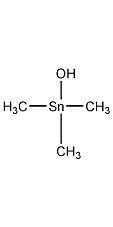
trimethyltin hydroxide

Trimethyltin hydroxide structural formula

Structural formula

Business number 017C
Molecular formula C3H10OSn
Molecular weight 180.8
label

Hydroxide

Numbering system

CAS number:56-24-6

MDL number:MFCD00013929

EINECS number:None

RTECS number:None

BRN number:None

PubChem ID:None

Physical property data

None

Toxicological data

1, acute toxicity: mouse subcutaneous LDLo: 1800ug/kg

Ecological data

None

Molecular structure data

None

Compute chemical data

1. Reference value for hydrophobic parameter calculation (XlogP): None

2. Number of hydrogen bond donors: 1

3. Number of hydrogen bond acceptors: 1

4. Number of rotatable chemical bonds: 0

5. Number of tautomers: none

6. Topological molecule polar surface area 1

7. Number of heavy atoms: 5

8. Surface charge: 0

9. Complexity: 11.6

10. Number of isotope atoms: 0

11. Determine the number of atomic stereocenters: 0

12. Uncertain number of atomic stereocenters: 0

13. Determine the number of chemical bond stereocenters: 0

14. Number of uncertain chemical bond stereocenters: 0

15. Number of covalent bond units: 2

Properties and stability

None

Storage method

None

Synthesis method

None

Purpose

None

extended-reading:https://www.bdmaee.net/reactive-composite-catalyst/
extended-reading:https://www.bdmaee.net/di-n-octyl-tin-dilaurate/
extended-reading:https://www.cyclohexylamine.net/catalyst-a400-polyurethane-catalyst-a400/
extended-reading:https://www.cyclohexylamine.net/polyurethane-gel-type-catalyst-dabco-low-odor-catalyst/
extended-reading:https://www.newtopchem.com/archives/644
extended-reading:https://www.newtopchem.com/archives/44732
extended-reading:https://www.cyclohexylamine.net/pc-cat-np109-low-odor-tertiary-amine-catalyst-polycat-9/
extended-reading:https://www.bdmaee.net/tmg-nnn%e2%80%b2n%e2%80%b2-tetramethylguanidine-cas80-70-6/
extended-reading:https://www.bdmaee.net/di-n-octyltin-oxide/
extended-reading:https://www.bdmaee.net/wp-content/uploads/2022/08/Dibutyl-tin-maleate-CAS78-04-6-tributyl-tin-oxide.pdf