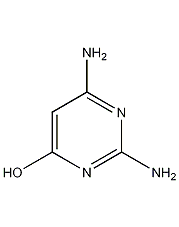
2,4-diamino-6-hydroxypyrimidine

2,4-diamino-6-hydroxypyrimidine structural formula

Structural formula

Business number 0175
Molecular formula C4H6N4O
Molecular weight 126.12
label

2,4-Diamino-6-hydroxypyrimidine,

2,6-Diamino-4-pyrimidinol,

2,6-Diamino-4-pyrimidinone,

Heterocyclic compounds

Numbering system

CAS number:56-06-4

MDL number:MFCD00149408

EINECS number:200-254-4

RTECS number:None

BRN number:125006

PubChem number:24278824

Physical property data

1. Properties: Yellow needle-like crystals

2. Density (g/mL, 25/4?): Undetermined

3. Relative vapor density (g/mL , air=1): Undetermined

4. Melting point (ºC): 260~270

5. Boiling point (ºC, normal pressure): Undetermined

6. Boiling point (ºC, 5.2kPa): Undetermined

7. Refractive index: Undetermined

8. Flash point (ºC): Undetermined

9. Specific rotation (º): Undetermined

10. Autoignition point or ignition temperature (ºC): Undetermined

11. Vapor pressure (kPa, 25ºC): Undetermined

12. Saturated vapor pressure (kPa, 60ºC): Undetermined

13. Heat of combustion (KJ/mol): Undetermined

14. Critical temperature (ºC): Undetermined

15. Critical pressure (KPa): Undetermined

16. Log value of oil-water (octanol/water) partition coefficient: Undetermined

17. Explosion upper limit (%, V/V): Undetermined

18. Explosion lower limit (%, V/V): Undetermined

19. Solubility: Not determined

Toxicological data

None

Ecological data

None

Molecular structure data

1. Molar refractive index: 32.78

2. Molar volume (cm3/mol): 78.8

3. Isotonic specific volume (90.2K ): 262.2

4. Surface tension (dyne/cm): 122.2

5. Polarizability (10-24cm3): 12.99

Compute chemical data

1. Hydrophobic parameter calculation reference value (XlogP): -1.8

2. Number of hydrogen bond donors: 3

3. Number of hydrogen bond acceptors: 4

4. Number of rotatable chemical bonds: 0

5. Number of tautomers: 17

6. Topological molecular polar surface area (TPSA): 93.5

7. Number of heavy atoms: 9

8. Surface charge: 0

9. Complexity: 205

10. Number of isotope atoms: 0

11. Determine the number of atomic stereocenters: 0

12. The number of uncertain atomic stereocenters: 0

13. The number of determined chemical bond stereocenters: 0

14. Uncertain chemical bond stereocenters Quantity: 0

15. Quantity of covalent bond units: 1

Properties and stability

Low toxicity. Operators should wear protective equipment to avoid contact with skin.

Storage method

This product should be sealed and stored away from light.

Plastic bag lined inside and woven bag packed outside. Store in a cool, ventilated, dry place, protected from sun and moisture, and away from fire and heat sources. When transporting, load and unload gently to avoid damage to the packaging.

Synthesis method

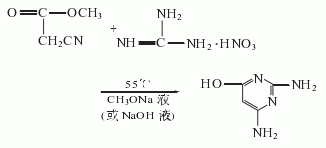
Heat and stir guanidine nitrate in sodium methoxide (or 50% NaOH) solution. After refluxing for half an hour, add methyl cyanoacetate dropwise and reflux for 2 hours. After the reaction is completed, heat and recover methanol. Heat water in the residue to dissolve it. When the temperature reaches 80°C, add acetic acid to adjust pH = 8 to precipitate product crystals. Cool to below 20°C, filter, wash and dry to obtain.
Purpose

For detection of nitrates and nitrites. Organic Synthesis. Pharmaceutical intermediates. It is used in the production of the drug Oncin-M, the antihypertensive drug Minadridine, and the anti-anemia drug folic acid.

extended-reading:https://www.cyclohexylamine.net/cas-1067-33-0-dibutyl-tin-diacetate/
extended-reading:https://www.newtopchem.com/archives/846
extended-reading:https://www.bdmaee.net/tmg-nnn%e2%80%b2n%e2%80%b2-tetramethylguanidine-cas80-70-6/
extended-reading:https://www.morpholine.org/category/morpholine/page/3/
extended-reading:https://www.newtopchem.com/archives/40383
extended-reading:https://www.bdmaee.net/dabco-bdma-catalyst-cas103-83-3-evonik-germany/
extended-reading:https://www.newtopchem.com/archives/1037
extended-reading:https://www.newtopchem.com/archives/762
extended-reading:https://www.newtopchem.com/archives/44586
extended-reading:https://www.cyclohexylamine.net/dabco-eg-pc-cat-td-33eg-niax-a-533/
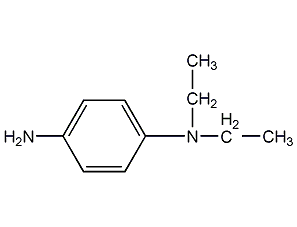
N,N-diethyl-p-phenylenediamine

N,N-diethyl-p-phenylenediamine structural formula

Structural formula

Business number 025P
Molecular formula C10H16N2
Molecular weight 164.25
label

4-diethylaminoaniline,

p-Amino-N,N-diethylaniline,

Diethyl p-phenylenediamine,

N,N-diethyl-1,4-phenylenediamine,

p-Amino-N,N-diethylaniline,

Diethyl-N,N-p-phenylenediamine,

4-(Diethylamino)aniline,

4-Diethylaminoaniline,

N,N-diethyl-p-phenylendiamine,

DPD,

4-(Diethylamino)aniline,

p-Amino-N,N-diethylaniline,

N,N-Diethyl-1,4-phenylenediamine,

developer

Numbering system

CAS number:93-05-0

MDL number:MFCD00007861

EINECS number:202-214-1

RTECS number:SS9275000

BRN number:879361

PubChem number:24855816

Physical property data

1. Properties: Light yellow liquid, changes color when exposed to light or air.

2. Density (g/mL, 25/4?): 0.988

3. Relative vapor density (g/mL, air=1): Undetermined

4. Melting point (ºC): 23

5. Boiling point (ºC, normal pressure): 260-262

6. Boiling point (ºC, 5.2kPa): Undetermined

7. Refractive index: 1.571

8. Flash point (ºC): 139

9. Specific rotation (º): Undetermined

10. Autoignition point or ignition temperature (ºC): Undetermined

11. Vapor pressure (kPa, 25ºC): Undetermined

12. Saturated vapor pressure ( kPa, 60ºC): Undetermined

13. Heat of combustion (KJ/mol): Undetermined

14. Critical temperature (ºC): Undetermined

15. Critical pressure (KPa): Undetermined

16. Log value of oil-water (octanol/water) partition coefficient: Undetermined

17. Explosion upper limit (%, V/ V): Undetermined

18. Lower explosion limit (%, V/V): Undetermined

19. Solubility: Can be mixed with alcohol and ether, insoluble in water.

Toxicological data

None

Ecological data

None

Molecular structure data

1. Molar refractive index: 54.06

2. Molar volume (cm3/mol): 162.7

3. Isotonic specific volume (90.2K ): 414.7

4. Surface tension (dyne/cm): 42.1

5. Polarizability (10-24cm3): 21.43

Compute chemical data

1. Reference value for hydrophobic parameter calculation (XlogP): None

2. Number of hydrogen bond donors: 1

3. Number of hydrogen bond acceptors: 2

4. Number of rotatable chemical bonds: 3

5. Number of tautomers: none

6. Topological molecule polar surface area 29.3

7. Number of heavy atoms: 12

8. Surface charge: 0

9. Complexity: 113

10. Number of isotope atoms: 0

11. Determine the number of atomic stereocenters: 0

12. Uncertain number of atomic stereocenters: 0

13. Determine the number of chemical bond stereocenters: 0

14. Number of uncertain chemical bond stereocenters: 0

15. Number of covalent bond units: 1

Properties and stability

This product is toxic and may cause obvious allergic reactions on skin contact.

Storage method

1. This product is toxic. Toxic chemicals such as diethylaniline and sodium nitrite are used in the production process. Therefore, the equipment must be sealed and production personnel must wear protective gear when operating. Reactive materials should be prevented from direct contact with skin or inhalation of dust.

2. Packed in an iron drum lined with plastic bags and stored in a cool, dry place away from light. Store and transport according to regulations on toxic chemicals.

Synthesis method

Using N,N-diethylaniline as raw material, it is obtained through nitrosation, reduction and neutralization: the process is as follows: (1) Nitrosation: Add 150kg water, 35kg N,N-diethylaniline and 72kg to the kettle Hydrochloric acid, cool to 0°C. At 0-5°C, add 50% sodium nitrite solution (prepared to 100% 18.5kg). After adding, stir for half an hour and add 6kg of salt. Stir for 2h. Filter to obtain p-nitroso-N,N-diethylaniline. (2) Reduction and neutralization Add 150kg water and 11kg hydrochloric acid to the kettle. Stir, add 41kg of iron powder, cool to 15°C, and add nitrite at 20-25°C. After the addition is completed, add 5kg of iron powder and stir at 20-25°C for 3 hours. Add 7kg of sodium carbonate, stir for 15 minutes, and filter. The filter cake is washed with hot water. Add 50kg liquid alkali (30%) and 15kg salt to the filtrate and washing liquid, and let stand for layering. The upper material distillation kettle is distilled under reduced pressure at 120-150°C and a vacuum of 8kPa to collect the fractions to obtain p-amino-N,N-diethylaniline.

Purpose

Dye intermediates. Its hydrochloride and sulfate can be used as color photographic developers.

extended-reading:https://www.bdmaee.net/wp-content/uploads/2022/08/Neodecanoic-acid-zinc-CAS27253-29-8-Zinc-neodecanoate.pdf
extended-reading:https://www.newtopchem.com/archives/805
extended-reading:https://www.newtopchem.com/archives/39778
extended-reading:https://www.bdmaee.net/tegoamin-bde/
extended-reading:https://www.bdmaee.net/reactive-composite-catalyst/
extended-reading:https://www.cyclohexylamine.net/dabco-eg-pc-cat-td-33eg-niax-a-533/
extended-reading:https://www.newtopchem.com/archives/category/products/page/4
extended-reading:https://www.newtopchem.com/archives/1137
extended-reading:https://www.bdmaee.net/polyurethane-rigid-foam-catalyst-cas15875-13-5-jeffcat-tr-90/
extended-reading:https://www.bdmaee.net/wp-content/uploads/2022/08/102-2.jpg

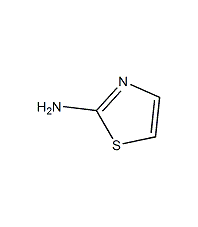
2-thiazolamine

2-thiazolamine structural formula

Structural formula

Business number 02B9
Molecular formula C3H4N2S
Molecular weight 100.14
label

2-Aminothiazol

Numbering system

CAS number:96-50-4

MDL number:MFCD00005325

EINECS number:202-511-6

RTECS number:XJ2100000

BRN number:105738

PubChem number:24846344

Physical property data

1. Properties: White to yellow crystals, gradually turning dark brown when exposed to air, easily sublimating.

2. Density (g/mL, 20?): Undetermined

3. Relative vapor density (g/mL, air=1): Undetermined

4. Melting point (ºC): 90

5. Boiling point (ºC, normal pressure): Undetermined

6. Boiling point (ºC, 1.46kPa): 140

7. Refractive index: Undetermined

8. Flash point (ºC): Undetermined

9. Specific rotation (º): Undetermined

10. Autoignition point or ignition temperature (ºC): Not determined

11. Vapor pressure (mmHg,ºC): Not determined

12. Saturated vapor pressure (kPa , ºC): Undetermined

13. Heat of combustion (KJ/mol): Undetermined

14. Critical temperature (ºC): Undetermined

15 . Critical pressure (KPa): Undetermined

16. Log value of oil-water (octanol/water) distribution coefficient: Undetermined

17. Explosion upper limit (%, V/V ): Undetermined

18. Lower explosion limit (%, V/V): Undetermined

19. Solubility: Slightly soluble in cold water, ethanol, easily soluble in hot water, Dilute inorganic acid.

Toxicological data

1. Acute toxicity: rat oral LD50: 480mg/kg; rat intravenous LD50: 570mg/kg; mouse peritoneal cavity LD50: 200mg/kg; cat oral LD50: 120mg/kg; rabbit oral LD50: 370mg /kg; guinea pig oral LDL0: 120mg/kg; 2. Other multiple dose toxicity: rabbit oral TDLo: 4500 mg/kg/56D-I; rabbit inhalation TCLo: 200 mg/m3/7H/61D-I; guinea pig inhalation TCLo: 200 mg/m3/7H/30D-I; TCLo inhaled by guinea pigs: 25mg/m3/7H/62D-I; 3. Mutagenicity: Mutant microorganism test: Bacteria – Salmonella typhimurium, 3333?g/plate; Mutant microorganism test : Klebsiella pneumoniae, 1mmol/L; mutation test of microorganisms: mouse lymphocytes, 1214mg/L; mutation test in mammalian body: mouse lymphocytes, 557mg/L;

Ecological data

This substance is slightly hazardous to water.

Molecular structure data

1. Molar refractive index: 26.96

2. Molar volume (cm3/mol): 74.4

3. Isotonic specific volume (90.2K ): 210.4

4. Surface tension (dyne/cm): 63.9

5. Polarizability (10-24cm3): 10.68

Compute chemical data

1.?Reference value for water parameter calculation (XlogP): None

2. Number of hydrogen bond donors: 1

3. Number of hydrogen bond acceptors: 3

4. Number of rotatable chemical bonds: 0

5. Number of tautomers: 2

6. Topological molecule polar surface area 67.2

7. Number of heavy atoms: 6

8. Surface charge: 0

9. Complexity: 48.1

10. Number of isotope atoms: 0

11. Determine the number of atomic stereocenters: 0

12. Uncertain number of atomic stereocenters: 0

13. Determine the number of chemical bond stereocenters: 0

14. Number of uncertain chemical bond stereocenters: 0

15. Number of covalent bond units: 1

Properties and stability

Avoid light. Avoid contact with strong oxidants, strong acids, acid chlorides, and acid anhydrides.

Storage method

Store in a cool, ventilated warehouse. Keep away from fire and heat sources. Keep container tightly sealed. They should be stored separately from oxidants, acids, and food chemicals, and avoid mixed storage. Equipped with the appropriate variety and quantity of fire equipment. Suitable materials should be available in the storage area to contain spills.

Synthesis method

It is obtained by the cyclization of thiourea and chloroacetaldehyde (or ethanol and chlorine, or ?, ? dichloroethyl ether). Add hot water, thiourea and ?,?-dichloroethyl ether to the reactor. Reflux with stirring for 2h. Cool and add sodium hydroxide solution through the dropping funnel to make the solution alkaline and precipitate 2-aminothiazole crystals. Then add diethyl ether to dissolve. The ether layer was separated, washed with water, dried over anhydrous sodium sulfate, and the ether was evaporated to obtain crude product. Recrystallize with ethanol to obtain yellow crystals. The yield is 80% and the melting point is 90°C.

Purpose

Used to synthesize sulfathiazole and antithyroid drugs, and as an intermediate in organic synthesis.

extended-reading:https://www.bdmaee.net/dibutyloxostannane/
extended-reading:https://www.newtopchem.com/archives/category/products/page/120
extended-reading:https://www.newtopchem.com/archives/44293
extended-reading:https://www.cyclohexylamine.net/cas-103-83-3-bdma-benzyldimethylamine/
extended-reading:https://www.newtopchem.com/archives/915
extended-reading:https://www.newtopchem.com/archives/45062
extended-reading:https://www.newtopchem.com/archives/44723
extended-reading:https://www.bdmaee.net/polyurethane-monosodium-glutamate/
extended-reading:https://www.newtopchem.com/archives/40394
extended-reading:https://www.newtopchem.com/archives/177