2,3-dibromo-1-propanol

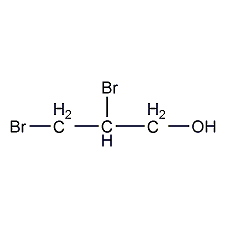
2,3-dibromo-1-propanol structural formula

Structural formula

Business number 02AH
Molecular formula C3H6Br2O
Molecular weight 217.89
label

2,3-Dibromopropanol,

Allyl alcohol dibromide,

2,3-Dibromopropanol,

2,3-Dibromo-1-propanol,

1,2-Dibromopropan-3-ol,

flame retardant,

Multifunctional solvent

Numbering system

CAS number:96-13-9

MDL number:MFCD00004699

EINECS number:202-480-9

RTECS number:UB0175000

BRN number:1719127

PubChem number:24893858

Physical property data

1. Properties: colorless oily liquid.

2. Density (g/mL, 20/4?): 2.14

3. Boiling point (ºC, normal pressure): 219d

4. Boiling point (ºC, 1.6KPa): 101

5. Refractive index (n20ºC): 1.5625

6. Flash point (ºC): 110

4. p>

7. Solubility: Soluble in alcohol, ether, benzene, acetone and acetic acid, slightly soluble in water.

Toxicological data

1. Skin/eye irritation: Standard Draize test: rabbit, eye contact: 100?L/24H, severity of reaction: severe.

2. Acute toxicity: Oral LD50 in rats: 681mg/kg; Inhalation LC50 in rats: 9920mg/m3/4H; Intraperitoneal LD50 in mice: 125mg/ kg; Rabbit skin contact LD50: 316mg/kg;

3. Other multiple dose toxicity: Rat by inhalation TCLo: 500mg/kg/4H-3W-I; Rat skin contact TDLo: 11505mg /kg/13W-I;

4. Chronic toxicity/carcinogenicity: Rat skin contact TDLo: 47940mg/kg/51W-I; Mouse skin contact TDLo: 37170mg/kg/42W- I;

5. Mutagenicity: Microbial Salmonella Typhimurium mutation: 203?g/plate;

Microbial Salmonella Typhimurium mutation: 3300?g/plate; Hamster cell mutation experiment: 20?mol/L ;

E. coli mutation: 313?g/plate; Drosophila oral sex chromosome loss and non-disjunction experiment: 500ppm;

Drosophila oral genetic translocation experiment: 500ppm ;DNA damage to rat cells: 1?mol/L;

                                    nbsp; DNA synthesis in rat liver: 100 ?mol/L; morphological transformation of hamster embryos: 500 ?mol/L;

6. Toxic when taken orally. Irritating to eyes, respiratory system and skin. There is the possibility of irreversible damage to the body.

Ecological data

None

Molecular structure data

1. Molar refractive index: 32.90

2. Molar volume (cm3/mol): 102.3

3. Isotonic specific volume (90.2K ): 269.8

4. Surface tension (dyne/cm): 48.4

5. Dielectric constant:

6. Dipole moment (10-24cm3):

7. Polarizability: 13.04

Compute chemical data

1. Reference value for hydrophobic parameter calculation (XlogP): 1.1

2. Number of hydrogen bond donors: 1

3. Number of hydrogen bond acceptors: 1

4. Number of rotatable chemical bonds: 2

5. Number of tautomers: none

6. Topological molecule polar surface area 20.2

7. Number of heavy atoms: 6

8. Surface charge: 0

9. Complexity: 32

10. Number of isotope atoms: 0

11. Determine the number of atomic stereocenters: 0

12. Uncertain number of atomic stereocenters: 1

13. Determine the number of chemical bond stereocenters: 0

14. Number of uncertain chemical bond stereocenters: 0

15. Number of covalent bond units: 1

Properties and stability

None

Storage method

Stored in a cool and dark place.

Synthesis method

1. Obtained from the addition of propylene alcohol and bromine. Add propylene alcohol to the carbon tetrachloride solvent, perform bromination when adding bromine at 25-27°C, keep the temperature for 1 hour after adding (at 50±2°C), then distill to recover carbon tetrachloride, wash with water and sodium carbonate to pH The value is 7-8, dry, filter and clear, distill under reduced pressure, and collect the 140-160°C (2.66kPa) fraction as the finished product. It can also be produced without solvent: add propylene alcohol into the reaction pot, stir and cool. Add bromine dropwise below 10°C. The dropping speed is preferably such that the reaction temperature does not exceed 20°C. After the addition is completed, stir at room temperature for 1.5 hours, add water and stir for 10 minutes, let it stand, separate the oil layer, add sodium carbonate solution to neutralize it to neutrality. Leave to stand, separate the oil layer, distill under reduced pressure, and collect the 115-125°C (3.99-5.32kPa) fraction to obtain 2,3-dibromo-1-propanol.

2. Preparation method:

                                                                                                                                                                                              p>

In a reaction bottle equipped with a stirrer, thermometer and dropping funnel, add 58g (1.0mol) of propylene alcohol (2) and 100mL of carbon tetrachloride. While cooling in a water bath, slowly add 160g of bromine dropwise. (1.0 mol), control the dropping speed to keep the temperature of the reaction solution at 25~27°C. After the addition is completed, slowly increase the temperature to 50°C and keep the reaction for 1 hour. Carbon tetrachloride was evaporated under reduced pressure, and the residue was washed with water and sodium carbonate solution until neutral. Dry with anhydrous sodium sulfate and distill under reduced pressure. Collect the fraction at 115~125?/4~5.2kPa to obtain 175g of 2,3-1-propanol (1) with a yield of 80%. [1]

Purpose

Used in organic synthesis as solvent and flame retardant. Used as an intermediate for antidote dimercaprol and polyurethane foam, unsaturated polyester, phenolic, epoxy resin and polypropylene flame retardant products.

extended-reading:https://www.bdmaee.net/cas-1067-33-0/
extended-reading:https://www.bdmaee.net/nt-cat-t26-catalyst-cas11207-74-9-newtopchem/
extended-reading:https://www.bdmaee.net/pmdeta/
extended-reading:https://www.bdmaee.net/high-rebound-delayed-catalyst-c-225/
extended-reading:https://www.bdmaee.net/wp-content/uploads/2016/05/Niax-catalyst-A-99.pdf
extended-reading:https://www.newtopchem.com/archives/40300
extended-reading:http://fh21com.cn”>
extended-reading:https://www.newtopchem.com/archives/1114
extended-reading:https://www.morpholine.org/127-08-2-2/
extended-reading:https://www.bdmaee.net/dabco-xd-103-dabco-tertiary-amine-catalyst-catalyst-xd-103/
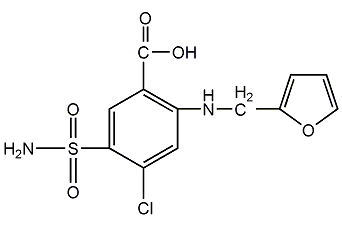
Furosemide

Frusemide structural formula

Structural formula

Business number 016C
Molecular formula C12H11ClN2O5S
Molecular weight 330.74
label

furosemide,

Diuretic,

furaniline,

sulfonamide,

Abdominal acidity,

4-Chloro-N-furfuryl-5-sulfamoylanthranilic acid,

5-(Aminosulfonyl)-4-chloro-2-([2-furanylmethyl]amino)benzoic acid

Numbering system

CAS number:54-31-9

MDL number:MFCD00010549

EINECS number:200-203-6

RTECS number:CB2625000

BRN number:None

PubChem number:24277714

Physical property data

1. Character:White or off-white crystalline powder, odorless, almost tasteless.


2. Density (g/mL,25/4?): Undetermined


3. Relative vapor density (g/mL,AIR=1): Undetermined


4. Melting point (ºC): 206


5. Boiling point (ºC,Normal pressure): Undetermined


6. Boiling point (ºC,5.2kPa): Undetermined


7. Refractive index: Undetermined


8. Flashpoint (ºC): Undetermined


9. Specific optical rotation (º): Undetermined


10. Autoignition point or ignition temperature (ºC): Undetermined


11. Vapor pressure (kPa,25ºC): Undetermined


12. Saturated vapor pressure (kPa,60ºC): Undetermined


13. Heat of combustion (KJ/mol): Undetermined


14. Critical temperature (ºC): Undetermined


15. Critical pressure (KPa): Undetermined


16. Oil and water (octanol/Log value of partition coefficient for water: undetermined


17. Explosion limit (%,V/V): Undetermined


18. Lower explosion limit (%,V/V): Undetermined


19. Solubility:Soluble in acetone, methanol, dimethylformamide, slightly soluble in ethanol, insoluble in water

Toxicological data

None

Ecological data

None

Molecular structure data


1. Molar refractive index: 75.76


2. Molar volume (m3/mol ): 205.8


3. isotonic specific volume (90.2K):606.2


4. Surface Tension (dyne/cm):75.2


5. Polarizability?10-24cm3):30.03


Compute chemical data

1. Reference value for hydrophobic parameter calculation (XlogP): None

2. Number of hydrogen bond donors: 3

3. Number of hydrogen bond acceptors: 7

4. Number of rotatable chemical bonds: 5

5. Number of tautomers: 4

6. Topological molecule polar surface area 131

7. Number of heavy atoms: 21

8. Surface charge: 0

9. Complexity: 481

10. Number of isotope atoms: 0

11. Determine the number of atomic stereocenters: 0

12. Uncertain number of atomic stereocenters: 0

13. Determine the number of chemical bond stereocenters: 0

14. Number of uncertain chemical bond stereocenters: 0

15. Number of covalent bond units: 1

Properties and stability

None

Storage method

This product should be sealed and stored in a cool, dry place.

Synthesis method

From 2, 4-dichlorobenzoic acid (see 12740) through chlorosulfonation, ammoniation and acidification to obtain 2, 4-dichloro-5-Sulfamoyl benzoic acid is then condensed with furfurylamine to produce furosemide.

Purpose

This product has a strong but short-lived diuretic effect. It is a powerful diuretic and is used to treat edema caused by heart, liver, kidney and other diseases. , especially in cases where base diuretics are ineffective; it can be used to treat acute pulmonary edema, cerebral edema, acute renal failure, hypertension and other diseases; combined with rehydration, this product can promote the non-excretion of poisons.

extended-reading:https://www.newtopchem.com/archives/555
extended-reading:https://www.bdmaee.net/dabco-eg-33-triethylenediamine-in-eg-solution-pc-cat-td-33eg/
extended-reading:https://www.bdmaee.net/dabco-mp602-delayed-amine-catalyst-non-emission-amine-catalyst/
extended-reading:https://www.morpholine.org/n-acetylmorpholine/
extended-reading:https://www.cyclohexylamine.net/delayed-catalyst-for-foaming-dabco-dc2-polyurethane-catalyst-dabco-dc2/
extended-reading:https://www.bdmaee.net/wp-content/uploads/2022/08/115-8.jpg
extended-reading:https://www.bdmaee.net/n-n-dimethyl-ethanolamine/
extended-reading:https://www.newtopchem.com/archives/685
extended-reading:https://www.cyclohexylamine.net/dabco-ne600-no-emission-amine-catalyst/
extended-reading:https://www.cyclohexylamine.net/high-quality-bis2dimethylaminoethylether-22%e2%80%b2-oxybisnn-dimethylethylamine-cas-3033-62-3-bdmaee/

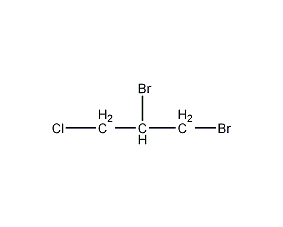
1,2-Dibromo-3-chloropropane

1,2-dibromo-3-chloropropane structural formula

Structural formula

Business number 02AG
Molecular formula C3H5Br2Cl
Molecular weight 236.33
label

Dibromochloropropane,

3-Chloro-1,2-dibromopropane,

Fumazone,

Nemagon,

Nemazont,

Dibromochloropropane,

soil fumigant,

nematicides,

Halogenated hydrocarbon solvents

Numbering system

CAS number:96-12-8

MDL number:MFCD00039365

EINECS number:202-479-3

RTECS number:TX8750000

BRN number:1732077

PubChem number:24862844

Physical property data

1. Properties: light yellow liquid with pungent odor.

2. Relative density (g/mL, 20/4?): 2.081

3. Relative vapor density (g/mL, air=1): 8.2

4. Melting point (ºC): 6

5. Boiling point (ºC, normal pressure): 200

6. Boiling point (ºC, 1.33KPa): 196

7. Refractive index (25ºC): 1.553

8. Flash point (ºC): 77

9. Saturated vapor pressure (kPa, 21ºC): 0.12

p>

10. Solubility: Slightly soluble in water, soluble in ethanol, acetone, hydrocarbons, etc. Miscible with oils, dichloropropane and isopropyl alcohol.

Toxicological data

1. Irritation: Rabbit transdermal: 10 g severe irritation. Rabbit eye: 1% mild irritation.

2. Acute toxicity: Oral LD5O in rats: 170mg/kg

Oral LD5O in mice: 260mg/kg

Inhalation LC50 in rats: 154ppm, 4 hours 3. Harmful to human body. It is highly toxic and has been found to be carcinogenic in oral tests on mice.

Ecological data

This substance is harmful to the environment. Special attention should be paid to the pollution of water and air. It is extremely destructive to the atmospheric ozone layer.

Molecular structure data

1. Molar refractive index: 36.21

2. Molar volume (cm3/mol): 116.1

3. Isotonic specific volume (90.2K ): 291.6

4. Surface tension (dyne/cm): 39.6

5. Dielectric constant:

6. Dipole moment (10-24cm3):

7. Polarizability: 14.35

Compute chemical data

1. Hydrophobic parameter calculation reference value (XlogP): 2.4

2. Number of hydrogen bond donors: 0

3. Number of hydrogen bond acceptors: 0

4. Number of rotatable chemical bonds: 2

p>

5. Number of tautomers:

6. Topological molecular polar surface area (TPSA): 0

7. Number of heavy atoms: 6

8. Surface charge: 0

9. Complexity: 32

10. Number of isotope atoms: 0

11. Determine the atomic configuration Number of centers: 0

12. Uncertain number of atomic stereocenters: 1

13. Determined number of chemical bond stereocenters: 0

14. Uncertain Number of stereocenters of chemical bonds: 0

15, number of covalent bond units: 1

Properties and stability

Avoid contact with strong oxidizing agents.

Storage method

Store in a cool, ventilated warehouse. Keep away from fire and heat sources. They should be stored separately from oxidants and food chemicals, and avoid mixed storage. Equipped with the appropriate variety and quantity of fire equipment. The storage area should be equipped with emergency release equipment and suitable containment materials.

Synthesis method

Add 3-chloropropene and bromine at normal pressure and 10-25°C, and the reaction product is purified by vacuum distillation. Add the original drug to the emulsifier and xylene, and emulsify at 55-60°C for half an hour to make an 80% emulsion. Raw material consumption quota: 3-chloropropene (92%) 310kg/t, liquid bromine 600kg/t

Purpose

Mainly used as solvent, soil fumigant, and nematicide.

extended-reading:https://www.newtopchem.com/archives/category/products/page/163
extended-reading:https://www.newtopchem.com/archives/44507
extended-reading:https://www.bdmaee.net/wp-content/uploads/2022/08/NEWTOP8.jpg
extended-reading:https://www.bdmaee.net/pc-cat-tka-metal-carboxylate-catalyst-nitro/
extended-reading:https://www.bdmaee.net/low-density-sponge-catalyst-smp/
extended-reading:https://www.bdmaee.net/pc-cat-np10-catalyst-n-dimethylaminopropyldiisopropanolamine/
extended-reading:https://www.bdmaee.net/lupragen-n400-catalyst-trimethylhydroxyethyl-ethylene-diamine-basf/
extended-reading:https://www.cyclohexylamine.net/strong-gel-amine-catalyst-bx405-low-odor-amine-catalyst-bx405/
extended-reading:https://www.bdmaee.net/wp-content/uploads/2022/08/124-2.jpg
extended-reading:https://www.newtopchem.com/archives/42953