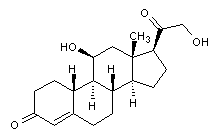
aldosterone

Aldosterone structural formula

Structural formula

Business number 015F
Molecular formula C21H28O5
Molecular weight 360.44
label

aldosterone,

aldosterone,

aldosterone,

11?,21-Dihydroxy-3,20-dioxo-4-pregnen-18-al,

11?,21-Dihydroxypregn-4-ene-3,18,20-trione,

18-Aldocorticosterone,

Reichstein X,

Electrocortin,

4-Pregnen-18-al-11?,21-diol-3,20-dione

Numbering system

CAS number:52-39-1

MDL number:MFCD00051136

EINECS number:200-139-9

RTECS number:TU4523000

BRN number:3224996

PubChem ID:None

Physical property data

1. Properties: The hydrated substance is colorless crystal.

2. Density (g/mL, 25/4?): Undetermined

3. Relative vapor density (g/mL, air=1): Undetermined

4. Melting point (ºC): 108~112? (the melting point of anhydrous is 164?). 5. Boiling point (ºC, normal pressure): Undetermined

6. Boiling point (ºC, 5.2kPa): Undetermined

7. Refractive index: Undetermined

8. Flash point (ºC): Undetermined

9. Specific rotation (º): Undetermined

10. Autoignition point or ignition temperature (ºC): Undetermined

11. Vapor pressure (kPa, 25ºC): Undetermined

12. Saturated vapor pressure (kPa, 60ºC): Undetermined

13. Heat of combustion (KJ/ mol): Undetermined

14. Critical temperature (ºC): Undetermined

15. Critical pressure (KPa): Undetermined

16. Oil and water ( Log value of the partition coefficient (octanol/water): Undetermined

17. Explosion upper limit (%, V/V): Undetermined

18. Explosion lower limit (%, V/ V): Undetermined

19. Solubility: Soluble in ethanol, ether and chloroform, slightly soluble in water.

Toxicological data

1. Mutagenicity: Mutation test system – not other specifiedTEST system: non-mammalian cells – not otherwise specified: 70nmol/L; Rat intravenous DNA damage test: 23mg/kg; DNA synthesis test: 23mg/kg

Ecological data

None yet

Molecular structure data

None yet

Compute chemical data

1. Reference value for hydrophobic parameter calculation (XlogP): None

2. Number of hydrogen bond donors: 2

3. Hydrogen bond acceptorNumber: 5

4. Number of rotatable chemical bonds: 3

5. Number of tautomers: 20

6. Topological molecule polar surface area 91.7

7. Number of heavy atoms: 26

8. Surface charge: 0

9. Complexity: 682

10. Isotopes Number of atoms: 0

11. Determine the number of atomic stereocenters: 7

12. Uncertain number of atomic stereocenters: 0

13. Determine chemical bonds Number of stereocenters: 0

14. Number of stereocenters of uncertain chemical bonds: 0

15. Number of covalent bond units: 1

Properties and stability

None yet

Storage method

Seal and store at 0-4ºC.

Synthesis method

None yet

Purpose

1. Biochemical research. Induces the urinary excretion of potassium ions and the kidneys to absorb sodium ions.

extended-reading:https://www.bdmaee.net/wp-content/uploads/2022/08/Dimethyl-tin-oxide-2273-45-2-CAS2273-45-2-Dimethyltin-oxide.pdf
extended-reading:https://www.bdmaee.net/n-dimethylpropylamine/
extended-reading:https://www.bdmaee.net/niax-a-133-tertiary-amine-catalyst-momentive/
extended-reading:https://www.newtopchem.com/archives/40573
extended-reading:https://www.newtopchem.com/archives/category/products/page/128
extended-reading:https://www.bdmaee.net/wp-content/uploads/2022/08/stannous-octoate-CAS-301-10-0–T-9.pdf
extended-reading:https://www.newtopchem.com/archives/44245
extended-reading:https://www.bdmaee.net/pc-cat-tka30-catalyst-nitro/
extended-reading:https://www.bdmaee.net/dabco-t-catalyst-cas10294-43-5-evonik-germany/
extended-reading:https://www.cyclohexylamine.net/reaction-delay-catalyst-polycat-sa-102-delay-catalyst-polycat-sa-102/
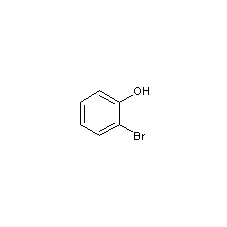
2-bromophenol

2-bromophenol structural formula

Structural formula

Business number 029D
Molecular formula C6H5BrO
Molecular weight 173.01
label

2-bromophenol,

o-bromophenol,

o-bromophenol,

?-Bromophenol,

BrC6H4OH,

Multifunctional solvents,

drug intermediates,

aromatic compounds

Numbering system

CAS number:95-56-7

MDL number:MFCD00002146

EINECS number:202-432-7

RTECS number:SJ7875000

BRN number:1905115

PubChem number:24847983

Physical property data

1. Properties: yellow to red oily liquid with unpleasant odor. [1]

2. Melting point (?): 5.6[2]

3. Boiling point (?): 195 [3]

4. Relative density (water = 1): 1.49[4]

5. Saturated vapor pressure (kPa): 1.73 (87.3?)[5]

6. Octanol/water partition coefficient: 2.35[6]

7. Flash point (?): 42.22[7]

8. Solubility: slightly soluble in water, soluble in ethanol, ether, etc. [8]

Toxicological data

1. Acute toxicity: Mouse oral LD50: 652mg/kg; Mouse abdominal LD50: 633mg/kg; Guinea pig subcutaneous LDLo: 1500mg/kg; Mammalian oral LD50: 650mg/kg; Mammalian oral LD50: 650mg/kg; Inhalation LC50: 1mg/m3;

2. Irritating to skin and mucous membranes.

3. Acute toxicity [9] LD50: 652mg/kg (mouse oral)

Ecological data

1. Ecotoxicity[10]

LC50: 16mg/L (48h) (medaka)

IC50: 78mg/L (72h) (algae)

2. Biodegradability No data available

3. Non-biodegradability No data yet

4. Bioaccumulation [11] BCF: 20~33 (carp, contact concentration 30ppb, contact time 6 weeks); 23~41 (carp, exposure concentration 3ppb, exposure time 6 weeks)

Molecular structure data

1. Molar refractive index: 35.82

2. Molar volume (cm3/mol): 104.0

3. Isotonic specific volume (90.2K ): 272.7

4. Surface tension (dyne/cm): 47.2

5. Polarizability (10-24cm3): 14.20

Compute chemical data

1. Reference value for hydrophobic parameter calculation (XlogP): None

2. Number of hydrogen bond donors: 1

3. Number of hydrogen bond acceptors: 1

4. Number of rotatable chemical bonds: 0

5. Number of tautomers: 3

6. Topological molecule polar surface area 20.2

7. Number of heavy atoms: 8

8. Surface charge: 0

9. Complexity: 74.9

10. Number of isotope atoms: 0

11. Determine the number of atomic stereocenters: 0

12. Uncertain atomic stereocenterNumber of stereocenters: 0

13. Determined number of stereocenters of chemical bonds: 0

14. Uncertain number of stereocenters of chemical bonds: 0

15. Number of covalent bond units: 1

Properties and stability

1. Stability[12] Stable

2. Incompatible substances[13] Acid chlorides, acid anhydrides, strong oxidants

3. Conditions to avoid contact[14] Heating

4. Polymerization hazard[15] No polymerization

5. Decomposition products[16] Hydrogen bromide

Storage method

Storage Precautions[17] Store in a cool, ventilated warehouse. Keep away from fire and heat sources. Keep container tightly sealed. They should be stored separately from oxidants and food chemicals, and avoid mixed storage. Use explosion-proof lighting and ventilation facilities. It is prohibited to use mechanical equipment and tools that are prone to sparks. The storage area should be equipped with emergency release equipment and suitable containment materials.

Synthesis method

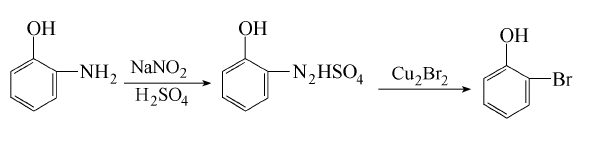
Obtained from o-aminophenol by diazotization and bromination: (1) Diazotization Stir o-aminophenol and water evenly, add concentrated sulfuric acid and crushed ice and cool down to below 5?. Slowly add sodium nitrite solution and keep the reaction temperature below 5°C to obtain diazonium salt. (2) Bromination Add cuprous bromide to hydrobromic acid to dissolve it, stir and add the heavy nitrogen salt, stir for 0.5h after adding, let it stand, steam distill until the distillate is oil-free, let it stand to separate the oil layer, and The oil is obtained by fractionation under reduced pressure.

Purpose

1. Manufacturing disinfectants, used in organic synthesis, pharmaceutical intermediates, and solvents.

2. Used in organic synthesis. [18]

extended-reading:https://www.bdmaee.net/n-butyltintrichloridemin-95/
extended-reading:https://www.newtopchem.com/archives/category/products/page/136
extended-reading:https://www.bdmaee.net/desmorepid-so-catalyst-cas112-96-9-rhine-chemistry/
extended-reading:https://www.bdmaee.net/polycat-17-pc-amine-ma-190-amine-balance-catalyst/
extended-reading:https://www.cyclohexylamine.net/tetramethyl-13-diaminopropane-tmeda/
extended-reading:https://www.cyclohexylamine.net/low-odor-amine-catalyst-bx405-low-odor-strong-gel-catalyst-bx405/
extended-reading:https://www.newtopchem.com/archives/789
extended-reading:https://www.newtopchem.com/archives/1604
extended-reading:https://www.cyclohexylamine.net/rigid-foam-catalyst-semi-rigid-foam-catalyst/
extended-reading:https://www.bdmaee.net/1-methylimidazole/

O-aminophenol

Ortho-aminophenol structural formula

Structural formula

Business number 029C
Molecular formula C6H7NO
Molecular weight 109
label

o-Hydroxyaniline,

2-Aminophenol,

1-amino-2-hydroxybenzene,

2-Amino-1-hydroxybenzene,

o-Aminophenol,

2-Aminophenol,

Aromatic nitrogen-containing compounds and their derivatives

Numbering system

CAS number:95-55-6

MDL number:MFCD00007690

EINECS number:202-431-1

RTECS number:SJ4950000

BRN number:606075

PubChem number:24891176

Physical property data

1. Properties: white or light gray crystalline powder. [1]

2. Melting point (?): 170~174[2]

3. Octanol/water Distribution coefficient: 0.52~0.62[3]

4. Solubility: soluble in cold water, ethanol, benzene, and ether. [4]

Toxicological data

1. Acute toxicity[5]

LD50: 951mg/kg (rat oral); 800mg/kg (mouse oral Oral); >1g/kg (guinea pig transdermal)

2. Irritation [6] Rabbit eye: 100mg, mild irritation .

3. Mutagenicity [7] Microbial mutagenicity: Salmonella typhimurium 333?g/dish.

4. Teratogenicity[8] The lowest toxic dose (TDLo) of 150mg/kg was given intraperitoneally to hamsters on the 8th day after pregnancy, causing damage to the central nervous system. , eyes, ears, and musculoskeletal system developmental malformations. DNA inhibition: hamster lung 19 ?mol/L.

Ecological data

1. Ecotoxicity No data yet

2. Biodegradability[9] When the COD value of 2-aminophenol is 200 mg/L, domesticated activated sludge is used, and the sludge concentration reaches 100 mg/L. After 5 days (aerobic), the COD removal rate is 95%.

3. Non-biodegradability[10] In the air, when the hydroxyl radical concentration is 5.00×10⁵ pcs/cm3, the degradation half-life is 5h (theoretical).

Molecular structure data

1. Molar refractive index: 32.37

2. Molar volume (cm3/mol): 90.1

3. Isotonic specific volume (90.2K ): 248.1

4. Surface tension (dyne/cm): 57.4

5. Polarizability (10-24cm3): 12.83

Compute chemical data

1. Reference value for hydrophobic parameter calculation (XlogP): None

2. Number of hydrogen bond donors: 2

3. Number of hydrogen bond acceptors: 2

4. Number of rotatable chemical bonds: 0

5. Number of tautomers: 7

6. Topological molecule polar surface area 46.2

7. Number of heavy atoms: 8

8. Surface charge: 0

9. Complexity: 74.9

10. Number of isotope atoms: 0

11. Determine the number of atomic stereocenters: 0

12. Uncertain number of atomic stereocenters: 0

13. Determined number of chemical bond stereocenters: 0

14. Uncertain number of chemical bond stereocenters: 0

15. Number of covalent bond units: 1

Properties and stability

1. Stability[11] Stable

2. Incompatible substances[12] Strong oxidants, acid chlorides, acid anhydrides, acids, chloroform

3. Conditions to avoid contact [13] Heat

>

4. Hazards of aggregation[14] No aggregation

Storage method

Storage Precautions[15] Store in a cool, ventilated warehouse. Keep away from fire and heat sources. The packaging is sealed. They should be stored separately from oxidants, acids, and food chemicals, and avoid mixed storage. Equipped with the appropriate variety and quantity of fire equipment. Suitable materials should be available in the storage area to contain spills.

Synthesis method

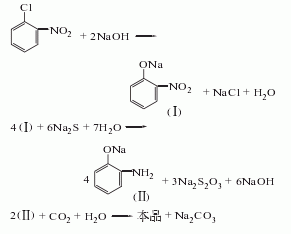
Heat o-nitrochlorobenzene in a sodium hydroxide solution and hydrolyze it under a certain pressure to obtain sodium o-nitrophenolate, which is then reduced with alkali sulfide. Then use carbonic acid to separate, cool, filter, soak in sodium bisulfite solution, centrifuge, and dry to obtain the finished product.


Purpose

1. Dye intermediates, used to manufacture sulfur dyes, azo dyes, fur dyes and fluorescent whitening agent EB, etc. Raw materials used in the pesticide industry for the pesticide phosphos.

2. Mainly used to make acid medium blue R, sulfur yellow brown, etc., and can also be used as fur dye. Used in the cosmetics industry to make hair dyes (as compound dyes).

3. Determination of silver and tin and verification of gold. Intermediate of diazo dyes and sulfur dyes.

4. Used in the manufacture of dyes, drugs, and plastic curing agents. [16]

extended-reading:https://www.bdmaee.net/246-trisdimethylaminomethylphenol/
extended-reading:https://www.morpholine.org/dabco-33-s-microporous-catalyst/
extended-reading:https://www.bdmaee.net/high-efficiency-catalyst-pt303/
extended-reading:https://www.bdmaee.net/fomrez-ul-29-catalyst-octylmercaptan-stannous-momentive-2/
extended-reading:https://www.bdmaee.net/cas-818-08-6-3/
extended-reading:https://www.newtopchem.com/archives/45041
extended-reading:https://www.newtopchem.com/archives/44147
extended-reading:https://www.bdmaee.net/wp-content/uploads/2022/08/NEWTOP7.jpg
extended-reading:https://www.newtopchem.com/archives/category/products/page/22
extended-reading:https://www.bdmaee.net/dabco-b-16-amine-catalyst-b16-dabco-b16/