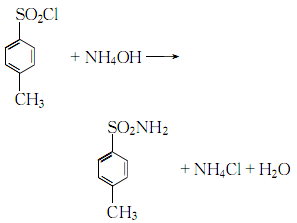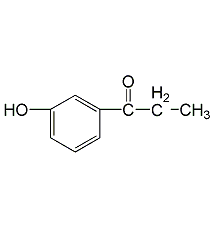
Structural formula
| Business number | 01GA |
|---|---|
| Molecular formula | C9H10O2 |
| Molecular weight | 150.18 |
| label |
p-Hydroxypropiophenone, 4-Hydroxypropiophenone, p-propionylphenol, Hydrolyzed polyacrylamide, HOC6H4COC2H5 |
Numbering system
CAS number:70-70-2
MDL number:MFCD00002361
EINECS number:200-743-2
RTECS number:UH1925000
BRN number:907511
PubChem ID:None
Physical property data
1. Character: white needle-like or prismatic crystal
2. Density (g/mL, 25/4?): Uncertain
3. Relative vapor density ( g/mL, air=1): Uncertain
4. Melting point (ºC): 36-38(lit.)
5. Boiling point (ºC, normal pressure): Not available Confirm
6. Boiling point (ºC, 26mmHg): 152-154(lit.)
7. Refractive index: Uncertain
8. Flash point ( ºF): >230
9. Specific rotation (º): Uncertain
10. Autoignition point or ignition temperature (ºC): Uncertain
11. Vapor pressure (kPa, 25ºC): Uncertain
12. Saturated vapor pressure (kPa, 60ºC): Uncertain
13. Heat of combustion (KJ/mol): Uncertain
14. Critical temperature (ºC): Uncertain
15. Critical pressure (KPa): Uncertain
16. Oil and water (octanol/ Log value of the partition coefficient (water): Uncertain
17. Explosion upper limit (%, V/V): Uncertain
18. Explosion lower limit (%, V/V): Uncertain
19. Solubility: Slightly soluble in water (0.34 g/l, 15 ºC), easily soluble in boiling water, miscible with alcohol and ether
Toxicological data
Acute toxicity: rat oral LD: >500 mg/kg; mouse intraperitoneal LD50: 200 mg/kg; mouse subcutaneous injection LD50: 1130 ug/kg; kg; breeding: rat intramuscular TDLo: 1600 mg/kgSEX/DURATION: female 15-30 day(s) after conception;
Ecological data
None
Molecular structure data
1. Molar refractive index: 42.79
2. Molar volume (cm3/mol): 135.9
3. Isotonic specific volume (90.2K ): 347.2
4. Surface tension (dyne/cm): 42.6
5. Polarizability (10-24cm3): 16.96
Computing chemical data
1. Reference value for hydrophobic parameter calculation (XlogP): None
2. Number of hydrogen bond donors: 1
3. Number of hydrogen bond acceptors: 2
4. Number of rotatable chemical bonds: 2
5. Number of tautomers: 7
6. Topological molecule polar surface area 37.3
7. Number of heavy atoms: 11
8. Surface charge: 0
9. Complexity: 135
10. Number of isotope atoms: 0
11. Determine the number of atomic stereocenters: 0
12. Uncertain number of atomic stereocenters: 0
13. Determine the number of chemical bond stereocenters: 0
14. Number of uncertain chemical bond stereocenters: 0
15. Number of covalent bond units: 1
Properties and stability
None
Storage method
This product should be sealed and stored in a cool, dry and dark place.
Synthesis method
Add anhydrous aluminum trichloride to carbon disulfide, stir, and add phenyl propionate dropwise. The reaction occurs immediately and hydrogen chloride is released. The carbon disulfide refluxes due to the heat generated by the reaction. After the dropwise addition is completed, the reaction mixture is heated to reflux for 2 hours until hydrogen chloride no longer escapes. The carbon disulfide is evaporated, the temperature is raised to 140-150°C and kept for 3 hours, and hydrogen chloride is released. The resulting resinous substance is cooled, and hydrochloric acid and water are slowly added to decompose the aluminum double salt. Place in the refrigerator overnight, filter, and recrystallize the filter cake with methanol to obtain p-hydroxypropiophenone, with a yield of 34-39%.
Purpose
Organic synthesis. Used as liquid crystal raw materials and intermediates.
extended-reading:https://www.newtopchem.com/archives/44462extended-reading:https://www.bdmaee.net/jeffcat-dmea-catalyst-cas107-15-3-huntsman/extended-reading:https://www.newtopchem.com/archives/44971extended-reading:https://www.newtopchem.com/archives/44428extended-reading:https://www.morpholine.org/delayed-catalyst/extended-reading:https://www.bdmaee.net/wp-content/uploads/2020/07/NEWTOP4.jpgextended-reading:https://www.bdmaee.net/wp-content/uploads/2022/08/42.jpgextended-reading:https://www.bdmaee.net/wp-content/uploads/2022/08/Dibutyltin-monooctyl-maleate-CAS25168-21-2-BT-58C.pdfextended-reading:https://www.bdmaee.net/jeffcat-zr-70-catalyst-cas1704-62-7-huntsman/extended-reading:https://www.newtopchem.com/archives/1875
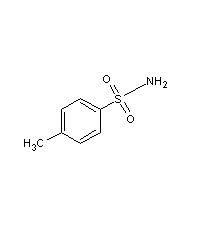
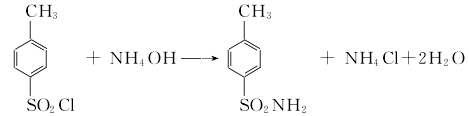 Process flow: first put an appropriate amount of ice water into the amination pot, and then mix it according to the mass Ratio (p-toluenesulfonyl chloride: pure ammonia = 1:0.2). Put the measured p-toluenesulfonyl chloride and ammonia water into the pot in sequence, start the stirrer, and use the cold liquid in the amination pot jacket to control the temperature in the pot to about 70°C. (This reaction generates a lot of heat), then lower the temperature to about 30°C and discharge the material. Put the amination into a filter bucket and filter, wash with warm water, and blot dry to obtain solid powdery crude p-toluenesulfonamide. Crude p-toluenesulfonamide contains a small amount of o-toluene sulfonamide by-product, oily colored substance. The purpose of purification and refining can be achieved by utilizing the property of para-amine to be easily soluble in sodium hydroxide solution and using activated carbon for decolorization. The material mass ratio is crude para-amine: 30% sodium hydroxide, liquid alkali: water = 100: 45: 1300; crude para-amine: activated carbon = 100: (2.5-3.5). Put the water and caustic soda into the purification pot according to the formula amount, open the jacketed steam valve and heat it to 70°C, then add the formula amount of crude para-amine, start the rear stirrer, and wait until the crude para-amine is completely dissolved. Add the formula amount of activated carbon, continue stirring for 0.5h, put the material liquid into the filter barrel, filter it with heat, wash it with hot water, and suck it dry. The filtrate is immediately poured into the refining pot, neutralized with hydrochloric acid to PH value = 2-3, and cooled to about 30-35°C. The material liquid is put into a filter barrel to filter, then washed with water until neutral, moved to a centrifuge and centrifuged to dry, that is It is a finished product containing 10% water. If a dry product is required, it is sent to an air flow dryer for drying to obtain a finished p-toluenesulfonamide product containing 1% water.
 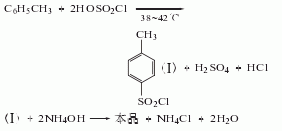 2.
2.