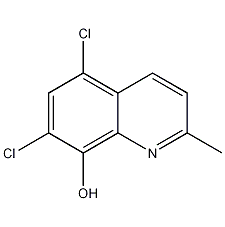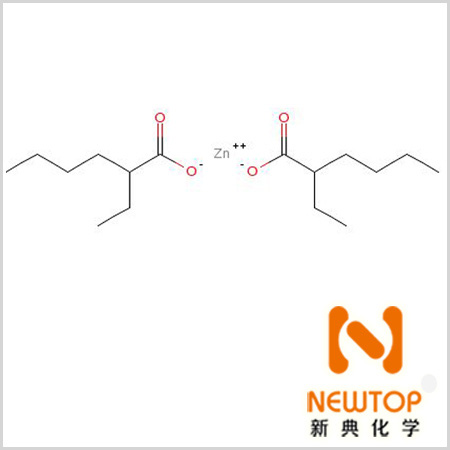
5,7-Dichloro-2-methyl-8-hydroxyquinoline

5,7-Dichloro-2-methyl-8-hydroxyquinoline structural formula

Structural formula

Business number 01H9
Molecular formula C10H7Cl2NO
Molecular weight 228.07
label

Chloroquinadol,

5,7-Dichloro-2-methyl-8-hydroxyquinoline,

5,7-Dichloro-8-hydroxyquinaldine,

5,7-Dichloro-2-methyl-8-hydroxyquinoline,

5,7-Dichloro-8-quinaldol,

5,7-Dichloro-2-methyl-8-quinolinol,

Hydroxydichloroquinaldine,

BCM

Numbering system

CAS number:72-80-0

MDL number:MFCD00023984

EINECS number:200-789-3

RTECS number:VC5600000

BRN number:156683

PubChem number:24893930

Physical property data

1. Character: Uncertain


2. Density (g/mL,25/4?): Unsure


3. Relative vapor density (g/mL,AIR=1): Unsure


4. Melting point (ºC):108-112 (dec.)(lit.)


5. Boiling point (ºC,Normal pressure): Unsure


6. Boiling point (ºC, 5.2 kPa): Unsure


7. Refractive index:Not sure


8. Flash Point (ºC): Unsure


9. Specific optical rotation (º): Unsure


10. Autoignition point or ignition temperature (ºC): Unsure


11. Vapor pressure (kPa,25 ºC): Unsure


12. Saturated vapor pressure (kPa,60 ºC): Unsure


13. Heat of combustion (KJ/mol): Unsure


14. Critical temperature (ºC): Unsure


15. Critical pressure (KPa): Unsure


16. Oil and water (octanol/Log value of water) partition coefficient: Uncertain


17. Explosion limit (%,V/V): Unsure


18. Lower explosion limit (%,V/V): Unsure


19. Solubility:Insoluble in water

Toxicological data

Acute toxicity: Rat oral administration LD50: 660 mg/kg; dog oral administration LD50: 2250 mg/kg;Rabbit oral LD50?160 mg/kg;
Mutagenic:Aspergillus nidulansSex chromosome nondisjunction loss and testing system ?1 gm/L;

Ecological data

None

Molecular structure data

5. Molecular property data:


1. Molar refractive index: 58.68


2. Molar Volume (m3/mol):155.3


3. isotonic specific volume (90.2K):429.6


4. Surface Tension (dyne/cm):58.4


5. Polarizability?10-24cm3):23.26

Compute chemical data

1. Reference value for hydrophobic parameter calculation (XlogP): 3.5

2. Number of hydrogen bond donors: 1

3. Number of hydrogen bond acceptors: 2

4. Number of rotatable chemical bonds: 0

5. Number of tautomers: 2

6. Topological molecule polar surface area 33.1

7. Number of heavy atoms: 14

8. Surface charge: 0

9. Complexity: 214

10. Number of isotope atoms: 0

11. Determine the number of atomic stereocenters: 0

12. Uncertain number of atomic stereocenters: 0

13. Determine the number of chemical bond stereocenters: 0

14. Number of uncertain chemical bond stereocenters: 0

15. Number of covalent bond units: 1

Properties and stability

None

Storage method

None

Synthesis method

None

Purpose

None

extended-reading:https://www.cyclohexylamine.net/balance-catalyst-ne210-dabco-amine-catalyst/
extended-reading:https://www.cyclohexylamine.net/non-emission-amine-catalyst-non-emission-delayed-amine-catalyst/
extended-reading:https://www.morpholine.org/dabco-33-s-microporous-catalyst/
extended-reading:https://www.bdmaee.net/toyocat-dt-strong-foaming-catalyst-pentamethyldiethylenetriamine-tosoh/
extended-reading:https://www.bdmaee.net/dimethyltin-dioctanoate/
extended-reading:https://www.bdmaee.net/low-odor-reaction-type-9727-catalyst-9727-reaction-type-catalyst-9727/
extended-reading:https://www.cyclohexylamine.net/spraying-catalyst-composite-amine-catalyst/
extended-reading:https://www.cyclohexylamine.net/dimethyltin-oxide-cas-2273-45-2/
extended-reading:https://www.newtopchem.com/archives/category/products/adhesive-catalyst
extended-reading:https://www.newtopchem.com/archives/1112

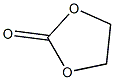
Ethylene carbonate

Ethylene carbonate structural formula

Structural formula

Business number 02B8
Molecular formula C3H4O3
Molecular weight 88.06
label

1,3-dioxolane-2-one,

1,3-dioxolone,

1,2-Ethanediolcarbonate,

1,3-Dioxalan-2-one,

Glycol carbonate,

foaming agent,

Extracting agent

Numbering system

CAS number:96-49-1

MDL number:MFCD00005382

EINECS number:202-510-0

RTECS number:FF9550000

BRN number:106249

PubChem number:24877564

Physical property data

1. Properties: Colorless and odorless needle-like or flaky crystals at room temperature.

2. Boiling point (ºC, 101.3kPa): 248

3. Melting point (ºC): 36

4. Relative density (g/mL, 25 /4ºC): 1.3208

5. Relative vapor density (g/mL, air=1): 3.04

6. Refractive index (40ºC): 1.4199

7. Refractive index (n50D): 1.4148

8. Viscosity (mPa·s, 40ºC) : 1.92

9. Viscosity (mPa·s, 60ºC): 1.42

10. Flash point (ºC): 160

11. Fire point (ºC) : 465

12. Heat of evaporation (KJ/mol): 50.2

13. Heat of fusion (KJ/mol): 10.05

14. Heat of combustion ( KJ/mol): 834.0

15. Specific heat capacity (KJ/(kg·K), 100ºC, constant pressure): 1.93

16. Boiling point rise constant: 0.043

17. Conductivity (S/m): <1×10⁻⁷

18. Vapor pressure (kPa, 36.4ºC): 0.0027

19. Solubility: Miscible with hot water (40°C), alcohol, benzene, chloroform, ethyl acetate, acetic acid, etc. Insoluble in dry ether, carbon disulfide, carbon tetrachloride, petroleum ether, etc.

20. Refractive index at room temperature (n25): 1.415850

21. Refractive index at room temperature (n 20): 1.419540

22. Relative density (25?, 4?): 1.320840

Toxicological data

1. Acute toxicity: rat oral LD50: 10g/kg; rabbit oral LD50: >3000mg/kg; rabbit oral LD50: 10.4g/kg.

2. Animal tests have proven that it has low toxicity and is irritating to skin and eyes. Rats inhaled concentrated vapor for 8 hours without death.

Ecological data

This substance is slightly hazardous to water.

Molecular structure data

1. Molar refractive index: 17.17

2. Molar volume (cm3/mol): 67.3

3. Isotonic specific volume (90.2K ): 166.3

4. Surface tension (dyne/cm): 37.3

5. Dielectric constant:

6. Dipole moment (10-24cm3):

7. Polarizability: 6.80

Compute chemical data

1. Reference value for hydrophobic parameter calculation (XlogP): 0.3

2. Number of hydrogen bond donors: 0

3. Number of hydrogen bond acceptors: 3

4. Number of rotatable chemical bonds: 0

5. Number of tautomers: none

6. Topological molecule polar surface area 35.5

7. Number of heavy atoms: 6

8. Surface charge: 0

9. Complexity: 60.4

10. Number of isotope atoms: 0

11. Determine the number of atomic stereocenters: 0

12. Uncertain number of atomic stereocenters: 0

13. Determine the number of chemical bond stereocenters: 0

14. Number of uncertain chemical bond stereocenters: 0

15. Number of covalent bond units: 1

Properties and stability

1. Avoid contact with oxidants, acids, and alkalis. It is a flammable liquid, please pay attention to the source of fire. Not corrosive to copper, mild steel, stainless steel or aluminum.

2. Chemical properties: relatively stable, alkali can accelerate its hydrolysis, while acid has no promoting effect on hydrolysis. In the presence of metal oxides, silica gel, and activated carbon, it decomposes at 200°C to generate carbon dioxide and ethylene oxide. When reacting with phenol, carboxylic acid, and amine, ?-hydroxyethyl ether, ?-hydroxyethyl ester, and ?-hydroxyethyl ethyl carbamate are generated respectively. Boiled with alkali to form carbonate. Ethylene glycol carbonate is heated at high temperature using a base as a catalyst to generate polyethylene oxide. Under the action of sodium methoxide, sodium monomethyl carbonate is generated. Dissolve ethylene glycol carbonate in concentrated hydrobromic acid and heat it at 100°C for several hours in a sealed tube to decompose into carbon dioxide and vinyl bromide.

3. Exist in smoke.

Storage method

Store in a cool, ventilated warehouse. Keep away from fire and heat sources. should be kept away from oxidizer, do not store together. Equipped with the appropriate variety and quantity of fire equipment. The storage area should be equipped with emergency release equipment and suitable containment materials.

Synthesis method

1. Obtained from the reaction of ethylene oxide and carbon dioxide.

Refining method: Distillation under reduced pressure, the distillate is dissolved in ether, cooled, crystallized, filtered, and then recrystallized with anhydrous ether to obtain the pure product.

2.Add 800 ml (6.6 mol) into a three-neck flask equipped with a stirrer and radium separation columnDiethyl carbonate and 335 ml (6.0 mol) ethylene glycol, heat and stir until the temperature of the reaction solution reaches 100-105°C and the two liquid layers are miscible with each other. Remove the stirrer and add 0.3 g Anhydrous potassium carbonate and some broken magnetic pieces are heated to steam out ethanol. The temperature at the top of the separation column should not exceed 80°C, and about 98% of the theoretical amount of ethanol can be steamed out. Cool, dissolve the distillation residue in 300 ml of absolute ethanol, filter, fully cool in an ice bath, filter again, and wash the crystals with ether. Recrystallize anhydrous ethyl alcohol and dry it in a vacuum dryer containing phosphorus pentoxide to obtain the product, with a yield of 51 to 55%.

Purpose

1. Currently it is mainly used in three aspects. (1) Used as water glass-based slurry to prepare pollution-free water glass-based slurry using 1,3-dioxolane and potassium bicarbonate as curing agent and quick-setting agent respectively. Due to the acrylamide and urea system Slurries are banned, and water glass-based slurries receive widespread attention. (2) Used to synthesize furazolidone (C8H7N3O5, [67-45-8]; this is a broad-spectrum antibacterial drug used to prevent coccidiosis in chickens. (3) Used as fiber finishing agent and other processing aids. Used in fertilizers, fibers, pharmaceuticals and organic synthesis, etc.

2. Used as a solvent for nylon, polyester, polyacrylonitrile, etc., a foaming agent for plastics and rubber, a stabilizer for synthetic lubricants, and Raw material for preparing drugs, carbonates, glycidyl, etc. It is also used to selectively extract aromatic hydrocarbons from mixtures of non-aromatic hydrocarbons.

extended-reading:https://www.bdmaee.net/dibutyltin-dibenzoate-cas1067-33-0-dibutyltin-dibenzoate-solution/
extended-reading:https://www.bdmaee.net/dabco-ne210-catalyst-cas10861-07-1-evonik-germany/
extended-reading:https://www.morpholine.org/127-08-2/
extended-reading:https://www.morpholine.org/polyester-sponge-special-catalyst-sponge-catalyst-dabco-ncm/
extended-reading:https://www.newtopchem.com/archives/44031
extended-reading:https://www.bdmaee.net/pc-cat-tko-catalyst-nitro/
extended-reading:https://www.cyclohexylamine.net/tmr-2-cas-62314-25-4-2-hydroxypropyltrimethylammoniumformate/
extended-reading:https://www.newtopchem.com/archives/44613
extended-reading:https://www.bdmaee.net/wp-content/uploads/2016/05/Lupragen-N205-MSDS.pdf
extended-reading:https://www.newtopchem.com/archives/39838

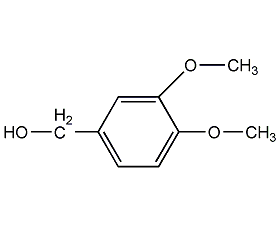
3,4-dimethoxybenzyl alcohol

3,4-dimethoxybenzyl alcohol structural formula

Structural formula

Business number 025M
Molecular formula C9H12O3
Molecular weight 168.19
label

3,4-dimethoxybenzyl alcohol,

veratryl alcohol,

Ververatrol,

3,4-Dimethoxyphenylmethyl alcohol,

(3,4-Dimethoxyphenyl)methanol

Numbering system

CAS number:93-03-8

MDL number:MFCD00004638

EINECS number:202-212-0

RTECS number:None

BRN number:639388

PubChem number:24893258

Physical property data

1. Properties: viscous oily liquid.

2. Density (g/mL, 25/4?): 1.157

3. Relative vapor density (g/mL, air=1): Undetermined

4. Melting point (ºC): Undetermined

5. Boiling point (ºC, normal pressure): 297

6. Boiling point (ºC, 5.2kPa): Undetermined

7. Refractive index: 1.5520

8. Flash point (ºC): >112

9. Specific rotation (º): Undetermined

10. Autoignition point or ignition temperature (ºC): Undetermined

11. Vapor pressure (kPa, 25ºC): Undetermined

12. Saturated vapor pressure ( kPa, 60ºC): Undetermined

13. Heat of combustion (KJ/mol): Undetermined

14. Critical temperature (ºC): Undetermined

15. Critical pressure (KPa): Undetermined

16. Log value of oil-water (octanol/water) partition coefficient: Undetermined

17. Explosion upper limit (%, V/ V): Undetermined

18. Lower explosion limit (%, V/V): Undetermined

19. Solubility: Soluble in organic solvents such as ethanol and ether.

Toxicological data

None

Ecological data

Water hazard level 1 (self-assessment via list) is slightly hazardous to water.

Do not allow undiluted or large amounts of product to come into contact with groundwater, waterways, or sewage systems.

Do not discharge materials into the surrounding environment without government permission.

Molecular structure data

1. Molar refractive index: 46.06

2. Molar volume (cm3/mol): 151.2

3. Isotonic specific volume (90.2K ): 374.1

4. Surface tension (dyne/cm): 37.4

5. Polarizability (10-24cm3): 18.26

Compute chemical data

1. Hydrophobic parameter calculation reference value (XlogP): 0.6

2. Number of hydrogen bond donors: 1

3. Number of hydrogen bond acceptors: 3

4. Number of rotatable chemical bonds: 3

5. Mutual Number of isomers:

6. Topological molecular polar surface area (TPSA): 38.7

7. Number of heavy atoms: 12

8. Surface charge : 0

9. Complexity: 127

10. Number of isotope atoms: 0

11. Determine the number of atomic stereocenters: 0

12. The number of uncertain atomic stereocenters: 0

13. The number of determined chemical bond stereocenters: 0

14. The number of uncertain chemical bond stereocenters: 0

15. Number of covalent bond units: 1

Properties and stability

None

Storage method

This product should be kept sealed.

Synthesis method

None

Purpose

Used in organic synthesis as a protective group for guanosine residues in oligonucleotide synthesis.

extended-reading:https://www.newtopchem.com/archives/1157
extended-reading:https://www.bdmaee.net/low-atomization-catalyst-9727/
extended-reading:https://www.newtopchem.com/archives/44203
extended-reading:https://www.bdmaee.net/ethanedioicacid-2/
extended-reading:https://www.bdmaee.net/di-n-butyl-tin-diisooctoate-cas2781-10-4-fascat4208-catalyst/
extended-reading:https://www.bdmaee.net/wp-content/uploads/2022/08/40.jpg
extended-reading:https://www.bdmaee.net/dibutyl-tin-oxide-food-grade/
extended-reading:https://www.newtopchem.com/archives/44236
extended-reading:https://www.bdmaee.net/fentacat-26-catalyst-cas111542-55-9-solvay/
extended-reading:https://www.bdmaee.net/rc-catalyst-104-cas112-05-6-rhine-chemistry/